
Miami-Dade Homestead Exemption Explained: What Homeowners Need to Know

Miami-Dade Homestead Exemption is a Florida property-tax benefit for qualifying homeowners who own and make a property their permanent residence.
It can reduce the property's taxable value and, once established, can also qualify the property for Florida's Save Our Homes assessment limitation.
For a recent buyer, applying for Homestead is especially important because the previous owner's exemption does not simply become yours after the property changes ownership.
Homestead Exemption can reduce taxable value today and establish important assessment protection for the years ahead.
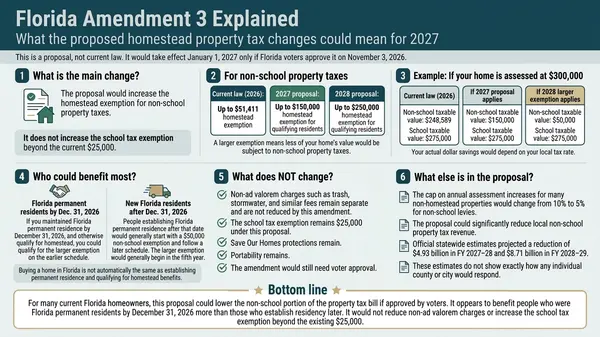
2026 ballot update: Florida voters will consider Amendment 3 on November 3, 2026. If approved, it would change the Homestead Exemption for non-school property taxes beginning in 2027. Read my guide to Florida Amendment 3 and the proposed property-tax changes. Until then, current law remains in effect.
If you're considering buying a Florida home around the 2026–2027 transition, read my guide to how the December 31 residency cutoff and January 1 Homestead requirements affect buyers.
What Is Homestead Exemption?
Homestead Exemption is a Florida property-tax exemption available to qualifying owners of a permanent residence.
Under current Florida law, a person generally must have legal or beneficial title to the property and make it their permanent residence as of January 1 of the tax year. Florida law requires exemption applications by March 1, subject to limited late-filing provisions.
In simple terms:
If you own a Miami-Dade home and genuinely use it as your permanent Florida residence, you may qualify for Homestead Exemption.
The Miami-Dade Property Appraiser makes the final eligibility determination.
What Does Homestead Exemption Actually Do?
Homestead affects property taxes in two important ways.
1. It can reduce taxable value
Part of your assessed value is exempt from certain property taxes.
2. It establishes eligibility for Save Our Homes
Beginning after the Homestead benefit is established, qualifying properties can receive Florida's Save Our Homes assessment limitation, which restricts annual growth in assessed value.
These are related benefits, but they are not the same thing.
|
Benefit |
What It Does |
|
Homestead Exemption |
Reduces taxable value |
|
Save Our Homes |
Limits future increases in assessed value |
|
Portability |
May allow an eligible homeowner to transfer a prior Save Our Homes assessment difference |
Homestead reduces taxable value. Save Our Homes limits assessment growth. Portability may transfer an existing assessment benefit from another Florida homestead.
How Much Is the Homestead Exemption in 2026?
The traditional explanation that Florida Homestead Exemption is simply “up to $50,000” is now incomplete.
For tax year 2026:
- The first $25,000 applies to all property-tax levies.
- A second exemption applies to assessed value above $50,000 and does not apply to school-district taxes.
- Beginning in 2025, that second portion receives an annual positive inflation adjustment.
- For 2026, the Florida Department of Revenue lists that additional exemption at $26,411.
That means the combined maximum exemption for applicable non-school taxes can reach $51,411 in 2026.
School taxes work differently because the additional exemption does not apply to school-district levies.
Homestead does not simply subtract the same amount from every taxing authority's taxable value.
This is why a TRIM notice may show different taxable values for different authorities.
A Simple Homestead Example
Suppose a qualifying homeowner has an assessed value of $400,000.
For illustration only:
- Assessed value: $400,000
- First Homestead portion: $25,000
- Additional 2026 Homestead portion for eligible non-school levies: up to $26,411
- Applicable non-school taxable value would therefore be lower than the original $400,000 assessed value.
School-board taxable value would be calculated differently because the additional portion does not apply to school taxes.
This is a simplified example, not an actual property-tax calculation.
Millage rates, other exemptions, property-specific circumstances, and non-ad valorem assessments can all affect the final bill.
Who May Qualify for Miami-Dade Homestead Exemption?
Miami-Dade states that a qualifying owner must generally have:
- Legal or equitable title as of January 1
- Permanent residence at the property as of January 1
- Appropriate evidence supporting Florida residency and permanent residence
The Property Appraiser may review documents such as a Florida driver's license or identification card, Florida vehicle registration, voter registration, tax records, bank statements, utility records, or a recorded Declaration of Domicile.
The rules can become more complicated when:
- A property is owned by several people
- Title is held in a trust
- Only some owners live in the property
- Part of the property is rented
- Ownership changes
- A spouse maintains another residence
- The property is inherited
If your situation is unusual, ask the Miami-Dade Property Appraiser rather than assuming you qualify or do not qualify.
Why Does January 1 Matter?
Homestead eligibility is determined based on the property's ownership and use as of January 1.
This creates an important timing issue for buyers.
If you buy a home on February 15, 2026, you did not own that property on January 1, 2026.
Your opportunity to establish Homestead on that property would generally be based on your ownership and permanent-residence status as of January 1, 2027.
This is one reason new buyers sometimes see the previous owner's tax situation reflected temporarily before their own exemption and assessment history begin.
For more detail, see our guide explaining why property taxes can increase after buying a Miami home.
What Is the Homestead Filing Deadline?
Miami-Dade states that applications and required documentation should be submitted by March 1 for the applicable tax year.
Florida law also provides limited late-filing procedures for otherwise qualified applicants under particular circumstances, but homeowners should not plan around those exceptions.
The simple rule is:
If you believe you qualify, apply by March 1.
Miami-Dade allows Homestead applications through its application portal and provides guidance on required documentation.
Do I Have to Reapply Every Year?
Generally, once an original Homestead Exemption has been approved, qualifying homeowners do not start the entire original application process from scratch every year.
However, homeowners are responsible for reporting changes that affect eligibility.
Miami-Dade specifically warns homeowners to notify the Property Appraiser when the property's use, ownership, or the owner's status changes in a way that affects the exemption.
Examples include:
- Moving out
- Renting the home
- Changing title
- Changing ownership percentages
- Making another property your permanent residence
A refinance by itself does not normally require a new Homestead application, although a title change connected with the transaction may require review.
Does Homestead Exemption Transfer When I Buy a Home?
No.
This is one of the most important misconceptions for Miami buyers.
The previous owner's Homestead Exemption does not become the new buyer's permanent exemption.
After you buy the property, you must qualify for and establish your own Homestead Exemption.
The same principle helps explain why the previous owner's property taxes may have been dramatically lower than yours.
A longtime owner may also have accumulated years of Save Our Homes assessment protection.
You buy the home, but you do not automatically inherit the previous owner's Homestead and accumulated Save Our Homes history.
What Is the Relationship Between Homestead and Save Our Homes?
Save Our Homes is one of the most valuable long-term benefits connected with Homestead.
Miami-Dade explains that beginning in the second year a property receives Homestead Exemption, increases in assessed value are generally limited to the lower of:
- 3%, or
- The applicable Consumer Price Index change.
Certain changes, including new construction, can be treated separately.
Over time, this can produce a gap between:
Market value
and
Assessed value
That difference is commonly called the Save Our Homes assessment difference or benefit.
For example:
|
Value |
Illustrative Amount |
|
Market value |
$700,000 |
|
Assessed value |
$475,000 |
|
Save Our Homes difference |
$225,000 |
These figures are illustrative only.
The homeowner's property might be worth $700,000 for assessment purposes, while taxes are based on a considerably lower assessed value before exemptions because Save Our Homes has limited assessment growth over time.
We explain Save Our Homes in detail in our guide to how the Save Our Homes cap works in Miami-Dade.
Does Homestead Mean My Taxes Cannot Go Up?
No.
This is another very common misunderstanding.
Homestead Exemption reduces taxable value, and Save Our Homes limits certain increases in assessed value.
Neither guarantees that your total tax bill will remain unchanged.
Your taxes may still change because of:
- Millage-rate changes
- Changes in exemptions
- New construction or improvements
- Non-ad valorem assessments
- Community Development District charges
- Changes involving the property or ownership
- Different taxable values among taxing authorities
For 2026, Miami-Dade's tax-comparison system reflects a 2.70% Save Our Homes assessment limitation for qualifying homestead property. That number limits applicable assessed-value growth, not the final percentage change in the entire tax bill.
A cap on assessed value is not the same as a cap on the final property-tax bill.
Does Homestead Reduce CDD or Other Non-Ad Valorem Assessments?
Generally, no.
Homestead affects ad valorem taxes, meaning taxes based on property value.
Non-ad valorem assessments are charges based on something other than taxable property value.
Those may include charges for services or districts such as:
- Community Development Districts
- Solid-waste services
- Lighting districts
- Landscaping districts
- Other special assessments
Therefore, reducing taxable value through Homestead does not necessarily reduce those charges.
For more information, see my complete guide to CDD fees and non-ad valorem assessments in Miami-Dade.
What Is Portability?
Portability is related to Save Our Homes, not simply to the basic Homestead Exemption.
An eligible Florida homeowner who leaves one homestead and establishes another may be able to transfer, or port, some or all of the accumulated Save Our Homes assessment difference to the new Florida homestead.
Florida's Department of Revenue confirms that Homestead Exemption itself is nontransferable, while qualifying homeowners may be able to transfer the assessment difference.
That is a very important distinction:
Homestead does not transfer. A qualifying Save Our Homes assessment benefit may be portable.
Portability has its own eligibility rules, timing requirements, and calculations. My guide to Florida Homestead Portability explains these requirements, including how the benefit is calculated when moving to a more or less expensive home.
What Should New Homeowners Verify After Buying?
Once you purchase a Miami-Dade home that will become your permanent residence, add these items to your homeowner checklist.
1. Confirm the Property Appraiser shows the correct ownership
Review the public property record after closing.
2. Determine when you become eligible for Homestead
Remember that January 1 controls eligibility for the tax year.
3. Apply by March 1
Do not assume Homestead happens automatically because you occupy the home.
4. Gather residency documentation
Make sure your records consistently reflect the property as your permanent residence.
5. Consider portability
If you previously had a Florida homestead, determine whether you may have an eligible Save Our Homes assessment difference to transfer.
6. Review your August TRIM notice
Once Homestead should be reflected, make sure you actually see the exemption on the Notice of Proposed Property Taxes.
Our guide to reading your Miami-Dade TRIM notice explains exactly where homeowners should focus.
7. Compare assessed and taxable values
Do not look only at the final proposed tax amount.
8. Ask questions promptly if something looks wrong
Exemption and assessment disputes can involve deadlines.
How Can I Confirm That My Homestead Exemption Was Applied?
Your annual Miami-Dade TRIM notice is one of the best checkpoints.
Look for the exemption section and confirm that Homestead appears when you expect it to.
You can also check the Miami-Dade Property Appraiser's online property information.
If you applied but do not see the benefit, contact the Property Appraiser rather than waiting until the November tax bill.
The best time to discover a missing exemption is while there is still time to ask questions about it.
Common Misunderstandings About Homestead Exemption
Myth: “I bought a home, so I automatically have Homestead.”
Reality: You must qualify and apply for your own Homestead Exemption.
Myth: “The seller had Homestead, so it transfers to me.”
Reality: The seller's permanent Homestead benefit does not simply become yours.
Myth: “Homestead means my taxes can never increase much.”
Reality: Homestead reduces taxable value. Save Our Homes separately limits certain assessed-value increases. Other parts of the tax bill can still change.
Myth: “Homestead reduces every tax by the same amount.”
Reality: The additional exemption does not apply to school-district taxes, so taxable values may differ among taxing authorities.
Myth: “Homestead and Save Our Homes are the same thing.”
Reality: Homestead is the exemption. Save Our Homes is an assessment limitation connected with qualifying homestead property.
Myth: “Portability means I move my Homestead Exemption to another house.”
Reality: Portability relates to transferring an eligible Save Our Homes assessment difference, not transferring the basic exemption itself.
Myth: “Once I have Homestead, I never need to think about it again.”
Reality: Changes in ownership, occupancy, rental use, or other circumstances can affect eligibility and should be reported.
What If I Rent Out My Homestead Property?
Be careful.
Miami-Dade states that rental use can affect Homestead eligibility.
A property used entirely as a rental generally does not qualify as the owner's Homestead. Partial rental arrangements may be treated differently depending on the circumstances.
Do not assume that a short-term, partial, or temporary rental has no property-tax consequences.
If you are considering renting a homesteaded property, ask the Miami-Dade Property Appraiser how your particular situation affects your exemption before making assumptions.
What If I Change the Title to My Home?
A title change deserves attention.
Adding or removing an owner, transferring property into certain entities or trusts, divorce, inheritance, and other ownership changes can affect how Homestead is treated.
Miami-Dade specifically notes that title changes may require a new application even when a refinance by itself would not.
When ownership changes, check with the Property Appraiser and, when appropriate, a Florida real estate attorney or title professional.
What Should I Do If My Homestead Is Missing?
If you believe you qualify but Homestead does not appear where expected:
- Verify your ownership information.
- Confirm that you met the January 1 residency and ownership requirements.
- Confirm that an application was filed.
- Check whether additional documentation was requested.
- Contact the Miami-Dade Property Appraiser.
- Review your TRIM notice carefully.
- Pay attention to any applicable review or appeal deadline.
Do not assume the November tax bill is the best time to investigate.
Can I Help You Understand What You Are Looking At?
Yes, within the appropriate limits.
I am a Realtor, not a tax professional or attorney, so I cannot determine whether you legally qualify for an exemption, calculate your tax liability, or give tax or legal advice.
But I regularly work with Miami-Dade property records.
If you recently purchased a home and you are unsure whether Homestead appears correctly, you are welcome to send me a screenshot of the property record or your TRIM notice. Feel free to cover any personal information first.
I can help you identify:
- Where the exemption appears
- Which value is assessed value
- Which value is taxable value
- Whether something deserves a question
- Which Miami-Dade Property Appraiser resource may help next
If the issue requires a formal eligibility determination, appeal, tax analysis, or legal interpretation, I can point you toward the appropriate professional or government office.
The Bottom Line
Miami-Dade Homestead Exemption is more than a one-year property-tax discount.
For qualifying homeowners, it can:
- Reduce taxable value
- Establish eligibility for Save Our Homes
- Help create long-term assessment protection
- Provide the foundation for possible portability when moving to another Florida homestead
But the benefit is tied to the qualifying homeowner and permanent residence.
The previous owner's Homestead does not simply become yours after closing.
If you recently purchased a Miami-Dade home that will be your permanent residence, verify your eligibility, apply by the applicable deadline, review your TRIM notice, and make sure the exemption appears correctly.
Homestead helps with today's taxable value. Save Our Homes can become even more important over time.
Frequently Asked Questions
What is Miami-Dade Homestead Exemption?
Homestead Exemption is a Florida property-tax benefit for qualifying homeowners who own and make a property their permanent residence. It reduces applicable taxable value and establishes eligibility for Save Our Homes.
Who qualifies for Homestead Exemption in Miami-Dade?
Generally, an owner must have qualifying legal or equitable title and make the property their permanent residence as of January 1. The Miami-Dade Property Appraiser makes the final determination.
When is the Homestead Exemption deadline in Miami-Dade?
The standard filing deadline is March 1 for the applicable tax year.
How much is Florida Homestead Exemption in 2026?
The first $25,000 applies to all property-tax levies. For 2026, the inflation-adjusted additional exemption is $26,411 for applicable non-school levies, meaning the combined maximum can reach $51,411 for those levies.
Does Homestead Exemption apply to school taxes?
The first $25,000 applies to school taxes, but the additional Homestead portion does not apply to school-district levies.
Does the seller's Homestead Exemption transfer when I buy the house?
No. A new buyer must independently qualify for and establish their own Homestead Exemption.
What is the difference between Homestead Exemption and Save Our Homes?
Homestead reduces taxable value. Save Our Homes limits certain annual increases in assessed value after qualifying Homestead is established.
When does Save Our Homes start?
Miami-Dade explains that beginning in the second year a property receives Homestead Exemption, qualifying assessed-value increases are limited under Save Our Homes.
Does Homestead mean my property taxes cannot increase?
No. Tax rates, non-ad valorem assessments, improvements, exemptions, and other factors can still change the total tax bill.
What is portability?
Portability may allow an eligible Florida homeowner to transfer part or all of a qualifying Save Our Homes assessment difference from a previous Florida homestead to a new one.
Can a rental property receive Homestead Exemption?
A property used as a rental rather than the owner's permanent residence generally does not qualify. Partial or temporary rental situations can be more complicated and should be verified with the Property Appraiser.
How do I know if my Homestead Exemption was applied?
Check the exemption information on your Miami-Dade property record and annual TRIM notice. Contact the Property Appraiser if an expected exemption is missing.
Recent Posts




GET MORE INFORMATION