
Why Did My Property Taxes Go Up After Buying a Home in Miami?
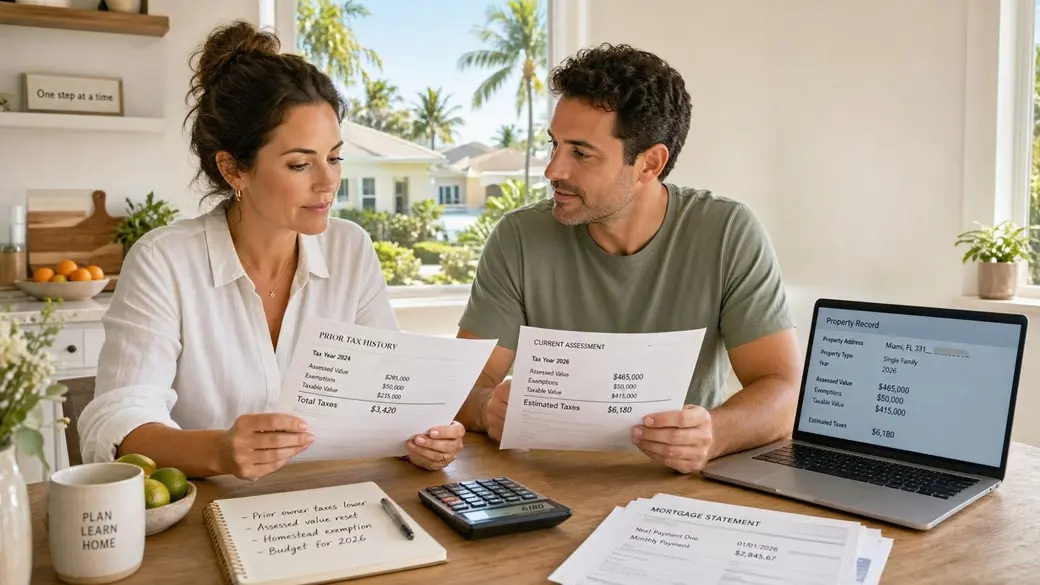
If your Miami-Dade property taxes became much higher after you bought your home, that does not automatically mean an error occurred.
One of the most common reasons is that the previous owner had a lower assessed value protected by Homestead Exemption and Florida's Save Our Homes benefit. After a change of ownership, that accumulated assessment protection generally does not stay with the property for the new buyer. The property may be reassessed closer to current market value for the following tax year.
That is why the seller's old property-tax bill can be very misleading when estimating what a buyer will eventually pay.
Main Answer: Why Do Property Taxes Often Increase After Buying a Miami Home?
A home sale can reset the property's tax assessment.
If the previous owner lived in the home for many years and received Homestead Exemption, Florida's Save Our Homes assessment limitation may have kept the property's assessed value far below its current market value.
When the property changes ownership, that accumulated Save Our Homes protection generally belongs to the prior owner's homestead situation, not automatically to the new buyer.
Miami-Dade's Property Appraiser explains that when a homesteaded property is sold, the prior Save Our Homes limitation is removed and the property is generally appraised at market value for the next tax year.
The purchase price is not added to the seller's old tax bill. Instead, the property's assessment situation may start over for the new owner.
Key Takeaways
- The seller's property-tax bill may reflect years of Save Our Homes protection.
- A sale can cause the property's assessed value to reset closer to market value the following year.
- The seller's Homestead Exemption does not permanently transfer to the buyer.
- An eligible buyer must apply for their own Homestead Exemption.
- Portability may help some Florida homeowners transfer part of a prior Save Our Homes benefit.
- Millage rates, exemptions, and non-ad valorem assessments can also change the final tax amount.
- Buyers with escrow accounts may later see their monthly mortgage payment increase when the lender adjusts for higher property taxes.
- A higher tax bill after a purchase does not automatically mean the county made a mistake.
Why the Seller's Tax Bill Can Be Misleading When You Are Buying a Home
Imagine a homeowner bought a Miami-Dade property many years ago.
Over time, the home's market value increased significantly. Because the owner qualified for Homestead Exemption, Save Our Homes limited the annual growth of the property's assessed value.
That means the owner's tax record might eventually look something like this:
|
Example |
Previous Owner |
New Buyer |
|
Current market value |
$650,000 |
$650,000 |
|
Assessed value before sale |
$360,000 |
Not yet reset |
|
Save Our Homes benefit |
$290,000 difference |
Prior owner's benefit does not simply transfer |
|
Homestead |
Previous owner |
Buyer must qualify and apply |
|
Future assessed value |
Protected under prior owner's history |
May reset closer to market value |
These numbers are only an illustration, not a tax calculation.
The point is that the prior owner's $360,000 assessed value may have had very little relationship to the property's current $650,000 market value.
If a buyer looks only at the seller's tax bill, the buyer could dramatically underestimate future taxes.
Miami-Dade's official Tax Estimator warns buyers not to use current or previous-year taxes as a reliable forecast of future taxes.
The seller's tax history reflects the seller's ownership history. It does not necessarily reflect the buyer's future tax situation.
What Is the Difference Between Market Value, Assessed Value, and Taxable Value?
These terms sound similar, but they mean different things.
Market Value
Market value, sometimes called just value for property-tax purposes, is the Property Appraiser's estimate of the property's value as of January 1.
It is not necessarily the same as:
- The purchase price
- A lender's appraisal
- An online home-value estimate
- A Realtor's comparative market analysis
- What the home might sell for several months later
Assessed Value
Assessed value is the value after applicable assessment limitations are considered.
For qualifying homestead property, Save Our Homes can keep assessed value below market value over time.
Miami-Dade explains that the difference between market value and assessed value created by Save Our Homes is the homeowner's accumulated Save Our Homes benefit.
Taxable Value
Taxable value is generally the assessed value minus applicable exemptions.
Florida's Department of Revenue summarizes the process as:
Just Value minus Assessment Limits = Assessed Value
Assessed Value minus Exemptions = Taxable Value
Taxable Value multiplied by Millage Rate = Ad Valorem Tax
Different taxing authorities can have different taxable values because not every exemption applies equally to every authority.
What Is Homestead Exemption?
Homestead Exemption is a Florida property-tax benefit available to qualifying owners who make the property their permanent residence.
Miami-Dade requires, among other qualifications, that the owner have legal or equitable title and establish permanent residence as of January 1. Applications are generally due by March 1.
Homestead can reduce taxable value and also establishes eligibility for the Save Our Homes assessment limitation.
But an important point for buyers is:
The seller's Homestead Exemption is not your Homestead Exemption.
Florida's Department of Revenue describes Homestead Exemption as nontransferable. A new owner who qualifies must establish their own benefit.
What Is Save Our Homes?
Save Our Homes is an assessment limitation connected to qualifying homestead property.
After the first year a property receives Homestead Exemption and is assessed at just value, future annual increases in assessed value are generally limited to the lower of:
- 3%, or
- The applicable Consumer Price Index change.
Over many years, this can create a large gap between market value and assessed value. That accumulated difference can help explain why a longtime homeowner's property taxes appear surprisingly low compared with the home's current value.
Why Doesn't the Seller's Save Our Homes Benefit Transfer to Me?
Because Save Our Homes is tied to the qualifying owner's homestead history.
When ownership changes, Florida generally requires the property to lose the previous owner's Save Our Homes benefit and be reassessed at just value on the following January 1.
There are statutory exceptions for certain transfers, such as some transfers between spouses and other qualifying ownership changes.
A normal arms-length sale to an unrelated buyer, however, typically creates the reassessment issue homeowners notice after purchase.
You are buying the property. You are not buying the previous owner's accumulated assessment history.
Why Might the Big Tax Increase Not Show Up Immediately?
This is where many new homeowners become confused.
Florida property taxes use a January 1 assessment date.
If you buy a home after January 1, the previous owner's Homestead Exemption and assessment limitation may remain reflected on the property for that tax year.
Miami-Dade's current Tax Estimator explains that a buyer purchasing after January 1 may effectively inherit the previous owner's Homestead Exemption and assessment limitation for the remainder of that year.
The following year, those prior-owner benefits are removed, and the property may receive a much higher assessed value.
A simple timeline
Suppose you close in May 2026.
January 1, 2026:
The seller owned the property and qualified for Homestead.
May 2026:
You purchase the home.
November 2026:
The tax bill may still largely reflect the property's January 1, 2026 assessment situation.
January 1, 2027:
The property is now assessed under the new ownership situation.
Later in 2027:
The higher assessed and taxable values may become much more visible.
This is why some buyers say:
“My taxes were fine the first year. Why did they jump the next year?”
The answer may simply be timing.
How Can Homestead Help the New Buyer?
If the Miami-Dade property becomes your permanent residence and you otherwise qualify, you can apply for your own Homestead Exemption.
Miami-Dade's general filing deadline is March 1.
Once your own Homestead Exemption is established, Save Our Homes can begin limiting future assessment increases according to Florida law.
But your new Save Our Homes history generally starts from the new ownership assessment unless you qualify for portability.
That distinction is important:
Homestead can help going forward. It does not usually restore the seller's accumulated Save Our Homes benefit.
What Is Portability?
Portability is a separate Florida property-tax benefit that may allow an eligible homeowner to transfer some or all of the Save Our Homes assessment difference from a previous Florida homestead to a new Florida homestead.
Miami-Dade currently states that qualifying homeowners may transfer up to $500,000 of assessment difference, subject to Florida's rules and calculations. The homeowner generally must establish the new Homestead Exemption within the required three-assessment-year window.
Portability is not automatic in every situation, and the calculation can differ when someone is upsizing, downsizing, changing ownership shares, or combining households.
For eligibility requirements and moving-up or downsizing examples, read my guide to Florida Homestead Portability.
For now, remember:
The seller's Save Our Homes benefit does not transfer to you, but your own prior Florida homestead benefit may be portable if you qualify.
What Are Millage-Based Property Taxes?
Florida property taxes based on value are called ad valorem taxes.
Taxing authorities apply their millage rates to the applicable taxable value.
Miami-Dade's TRIM notice may show taxes from several authorities, including:
- Miami-Dade County
- Miami-Dade County Public Schools
- Your municipality
- South Florida Water Management District
- Children's Trust
- Other applicable taxing authorities
The Miami-Dade Property Appraiser establishes values and exemptions, but it does not set the tax rates. Taxing authorities set their own millage rates.
That means your taxes can change even when the assessed value is not the only thing that changed.
What Are Non-Ad Valorem Assessments?
Non-ad valorem assessments are charges that are not calculated from the property's value.
Miami-Dade lists examples such as:
- Solid waste services
- Lighting districts
- Landscape districts
- Guard districts
- Community Development Districts, or CDDs
These amounts can change separately from your market value or millage rates.
This is another reason not every property-tax increase has the same explanation.
For a closer look at these property-specific charges, see my guide to CDD fees and other non-ad valorem assessments in Miami-Dade.
A higher total bill may come from assessed value, tax rates, exemptions, non-ad valorem assessments, or a combination of several factors.
Why Did My Monthly Mortgage Payment Suddenly Go Up Too?
If your mortgage includes an escrow account, your lender or servicer collects money each month to pay expenses such as property taxes and homeowners insurance.
When your property taxes increase, the amount your servicer needs to collect for escrow may also increase.
The Consumer Financial Protection Bureau confirms that changes in property taxes or homeowners insurance can change the escrow portion of a monthly mortgage payment.
This can create a second surprise.
Example
Your principal and interest payment may stay exactly the same.
But your lender discovers that the annual property tax bill will be higher than previously estimated.
The servicer may need to:
- Collect more each month for future taxes.
- Address an existing escrow shortage if the account did not collect enough.
The result can be a noticeable increase in the total monthly mortgage payment even though your mortgage interest rate did not change.
A higher mortgage payment after purchase may come from escrow, not from the loan itself.
If the escrow calculation looks wrong, contact your mortgage servicer and compare its figures with the actual property-tax and insurance information. The CFPB recommends contacting the servicer promptly when there appears to be an escrow problem.
What Does the TRIM Notice Have to Do With This?
Every August, Miami-Dade sends property owners a Notice of Proposed Property Taxes, commonly called the TRIM notice.
The TRIM notice is not a tax bill.
It shows:
- Property values
- Exemptions
- Assessment benefits
- Taxable values
- Proposed taxes
- Proposed millage rates
- Non-ad valorem assessments
- Public hearing information
For a recent buyer, the TRIM notice is one of the best places to see whether the reassessment, new Homestead Exemption, or other property-tax changes are appearing as expected.
For a complete walkthrough, see our guide to how to read your Miami-Dade TRIM notice without panicking.
How Should Buyers Estimate Property Taxes Before Purchasing?
Do not simply copy the seller's current property-tax amount into your budget.
A better starting point is to estimate taxes based on the buyer's likely future assessment situation.
Miami-Dade provides an official Property Tax Estimator specifically for this purpose. The county warns that it provides estimates only, not actual future taxes.
A useful pre-purchase review should consider:
- Approximate purchase price
- Likely future assessed value
- Whether the buyer will qualify for Homestead
- Whether portability may apply
- Current proposed or adopted millage rates
- Municipal location
- Non-ad valorem assessments
- CDD charges
- Other property-specific assessments
The question should not be, “What does the seller pay?”
The better question is:
“What might this property look like for tax purposes under my ownership?”
What Should I Check If My Property Taxes Increased?
Start with the facts before assuming something is wrong.
1. Check the ownership information
Make sure the Property Appraiser correctly reflects the ownership change.
2. Review the market value
Look at the property's current market or just value.
If the value appears inaccurate, review the property details and comparable information.
3. Check the assessed value
Compare the current assessed value with the previous year.
A large change after a sale may reflect removal of the prior owner's Save Our Homes cap.
4. Check your Homestead Exemption
If this is your permanent residence and you applied, confirm that the exemption appears correctly.
Miami-Dade encourages homeowners to review their TRIM notice to verify exemption changes.
5. Check portability
If you previously owned a Florida homestead and applied to transfer your assessment difference, confirm the benefit appears as expected.
6. Review taxable values
Remember that different taxing authorities may show different taxable values because exemptions do not always apply equally.
7. Review the millage rates
If your assessed value looks correct but taxes still increased, determine whether one or more taxing authorities changed their tax rates.
8. Review non-ad valorem assessments
Look for CDD, garbage, lighting, special district, or other charges that may have changed.
9. Compare your escrow analysis
If your mortgage payment increased, determine how much of the change came from property taxes versus homeowners insurance or an escrow shortage.
10. Contact the correct office
For questions about property value, assessed value, or exemptions, contact the Miami-Dade Property Appraiser.
For questions about millage rates, contact the taxing authority listed on your TRIM notice.
For questions about escrow, contact your mortgage servicer.
What If I Think the New Assessment Is Wrong?
Miami-Dade encourages property owners to contact the Property Appraiser for an informal review when they have concerns about property values or exemptions.
The office can review property information and discuss possible discrepancies.
If a valuation or exemption dispute cannot be resolved, a property owner may also have the right to petition the Miami-Dade Value Adjustment Board.
For the 2026 tax year, the deadline to file a timely VAB petition is September 18, 2026.
That date changes from year to year, so always check the current TRIM notice and official Miami-Dade resources rather than relying on an older article.
The Value Adjustment Board can address certain valuation, exemption, classification, portability, and ownership-related disputes. It cannot simply lower a taxing authority's millage rate because the resulting tax bill feels high.
A Simple Checklist for Recent Miami Homeowners
If your property taxes increased after purchasing your home, check:
- Was the property recently reassessed after the sale?
- Did the previous owner have Homestead?
- Did the previous owner have accumulated Save Our Homes protection?
- Did you apply for your own Homestead Exemption?
- Does your Homestead appear on the TRIM notice?
- Did you qualify and apply for portability?
- Is the market value reasonable?
- Is the assessed value understandable?
- Are the taxable values correct?
- Did millage rates change?
- Did non-ad valorem assessments change?
- Is there a CDD charge?
- Did your mortgage escrow payment change too?
- Is there an escrow shortage?
- Are any review or appeal deadlines approaching?
Can I Help You Make Sense of the Numbers?
Yes, within the appropriate limits.
I am a Realtor, not a tax professional or attorney, so I cannot determine your tax liability, give tax advice, or tell you whether to file a legal appeal.
But property-tax records are an important part of evaluating Miami real estate, and I work with them regularly.
If you recently purchased a home and the new tax amount looks confusing or much higher than expected, you are welcome to send me a screenshot or photo of what you are reviewing. Feel free to cover personal information first.
I can help you identify:
- Which value changed
- Whether Homestead appears
- Whether Save Our Homes may explain the previous owner's lower assessment
- Whether a non-ad valorem or CDD assessment appears
- Which official Miami-Dade resource may be able to answer your question
If the issue requires tax, legal, appraisal, or mortgage-servicing advice, I can point you toward the appropriate professional or agency.
The goal is simply to help you understand where the difference is coming from before assuming something went wrong.
The Bottom Line
A higher property-tax bill after buying a Miami home is often the result of a change in ownership and reassessment, not a mistake.
The previous owner may have benefited from years of Homestead Exemption and Save Our Homes protection that kept the assessed value far below market value. After the sale, that accumulated protection generally does not remain with the property for the buyer.
But reassessment is not the only reason taxes can change. Exemptions, millage rates, non-ad valorem assessments, CDD charges, property improvements, and other changes in the tax record can also affect the final amount.
The seller's old tax bill tells you what the seller paid. It does not tell you what you will pay.
Before buying, estimate taxes based on your likely future taxable value. After buying, review your TRIM notice and verify your exemptions and property information.
A higher amount deserves an explanation. It does not automatically mean an error occurred.
Frequently Asked Questions
Why did my property taxes increase after buying a house in Miami?
A sale can remove the previous owner's Save Our Homes assessment limitation. The property may then be reassessed closer to market value for the following tax year, resulting in a higher assessed and taxable value.
Why were the seller's property taxes so much lower than mine?
The seller may have owned the property for many years and accumulated significant Save Our Homes protection. Their assessed value may therefore have been much lower than the property's market value.
Does the seller's Homestead Exemption transfer to the buyer?
No, not as the buyer's permanent exemption. A buyer who qualifies must apply for their own Homestead Exemption. Depending on when the property is purchased, the seller's existing exemption may remain reflected for the rest of that tax year.
What happens to Save Our Homes when a property is sold?
A change of ownership generally removes the prior owner's Save Our Homes benefit, and the property can be reassessed at just value on the following January 1, subject to statutory exceptions.
Why did my taxes increase a year after I bought the home?
If you purchased after January 1, the seller's exemption and assessment limitation may have remained in effect for that tax year. The reassessment under the new ownership situation may become visible the following year.
Can I get Homestead Exemption after buying a Miami home?
If the property is your permanent residence and you meet the eligibility requirements, you may apply for Homestead Exemption. Miami-Dade's standard application deadline is March 1.
What is portability?
Portability may allow a qualifying Florida homeowner to transfer part or all of the Save Our Homes assessment difference from a previous Florida homestead to a new homestead. It is a separate benefit and requires its own eligibility and application process.
Can portability reduce my new home's assessed value?
Yes, for eligible homeowners. Miami-Dade currently permits qualifying portability transfers of up to $500,000 of assessment difference, subject to Florida's calculation rules.
Does my purchase price automatically become my assessed value?
Not necessarily. The Property Appraiser determines just value under Florida property-tax rules. A sale is important market evidence, but the Property Appraiser determines the official assessment.
Why did my mortgage payment increase after my property taxes went up?
If your loan has an escrow account, your mortgage servicer collects funds for property taxes and insurance. When taxes increase, the escrow portion of your monthly mortgage payment may also increase. An escrow shortage can create an additional temporary increase.
What are non-ad valorem assessments?
They are charges that are not calculated from property value. Examples can include solid waste, lighting districts, guard districts, landscaping districts, and Community Development District assessments.
Is a CDD charge part of my property tax?
A CDD assessment can appear on the same property-tax bill, but it is generally a non-ad valorem assessment rather than a tax calculated from your property's taxable value.
How can I estimate future property taxes before buying?
Use Miami-Dade's official Property Tax Estimator and enter information based on your anticipated ownership situation. Do not simply use the seller's current property-tax amount.
What should I do if I believe my property assessment is wrong?
Contact the Miami-Dade Property Appraiser for a review. If an eligible dispute cannot be resolved, you may have options through the Value Adjustment Board, subject to current filing deadlines.
Recent Posts





GET MORE INFORMATION