
Save Our Homes Explained for Miami-Dade Homeowners: How Florida’s Property Tax Cap Really Works
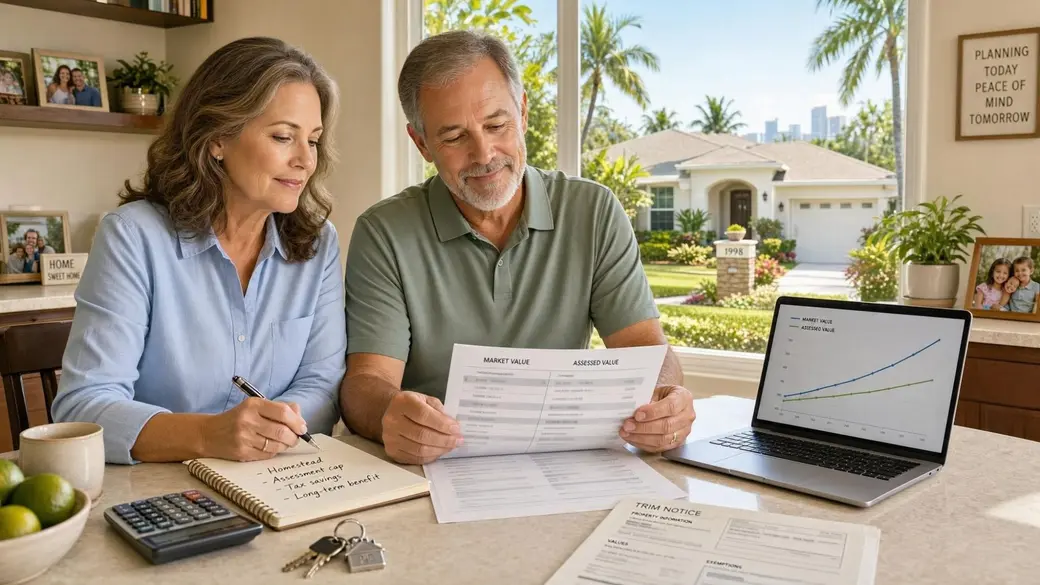
Florida’s Save Our Homes, often called SOH, limits how quickly the assessed value of a qualifying homesteaded property can increase from year to year.
For 2026, the Save Our Homes cap is 2.7%. That means the annual increase in assessed value is limited to the lower of 3% or the applicable Consumer Price Index change.
But Save Our Homes does not mean your total property-tax bill can increase by only 2.7% or 3%.
That distinction is one of the most important things Miami-Dade homeowners should understand.
Main Answer: What Is Save Our Homes?
Save Our Homes is a Florida constitutional assessment limitation for qualifying properties with Homestead Exemption.
After the property's Homestead base year, annual increases in assessed value generally cannot exceed the lower of:
- 3% of the prior year's assessed value, or
- the applicable Consumer Price Index change
Florida Statute 193.155 establishes that limitation.
For 2026, the applicable Save Our Homes cap is 2.7%, subject to the rules and exceptions below.
Save Our Homes protects assessed value from rising as quickly as market value. It does not freeze property taxes.
Key Takeaways
- Save Our Homes applies to qualifying properties with Homestead Exemption.
- The first Homestead year establishes the property's base assessment.
- Beginning the following year, annual assessed-value increases are limited.
- The limit is the lower of 3% or the applicable CPI change.
- The official 2026 cap is 2.7%.
- Market value can increase much faster than assessed value.
- The difference between market value and assessed value becomes the Save Our Homes benefit.
- Your tax bill can still rise even when Save Our Homes applies.
- A home sale can remove the previous owner's accumulated SOH benefit.
- Eligible Florida homeowners may be able to transfer part of their own SOH benefit through portability.
How Is Save Our Homes Different From Homestead Exemption?
Homestead Exemption and Save Our Homes work together, but they do different jobs.
|
Benefit |
What It Does |
|
Homestead Exemption |
Reduces taxable value |
|
Save Our Homes |
Limits future growth in assessed value |
|
Portability |
May transfer an eligible SOH assessment difference to another Florida homestead |
The Miami-Dade Property Appraiser explains that the base year is the first year an owner receives Homestead Exemption. During that year, market value and assessed value are generally equal. Save Our Homes begins affecting the assessment in the following year.
So a simple way to remember it is:
Homestead reduces taxable value today. Save Our Homes can protect assessed value over time.
For a complete explanation of the exemption itself, see our guide to Miami-Dade Homestead Exemption.
How Does Save Our Homes Work in Practice?
Consider a simplified example.
Suppose a qualifying Miami-Dade homeowner has:
2025 assessed value: $400,000
If the applicable 2026 SOH cap is 2.7%, a simplified maximum assessment calculation would be:
$400,000 × 1.027 = $410,800
Now suppose the Property Appraiser determines that the property's 2026 market value is $450,000.
Because the prior assessed value was substantially lower and Save Our Homes applies, the assessed value could remain around $410,800 rather than immediately jumping to $450,000, assuming no other assessment changes apply.
|
2026 Value |
Illustrative Amount |
|
Market value |
$450,000 |
|
Prior assessed value |
$400,000 |
|
2026 SOH cap |
2.7% |
|
Illustrative assessed value |
$410,800 |
|
Difference from market value |
$39,200 |
This is an educational illustration, not a tax calculation for a particular property.
The important idea is that market value and assessed value can begin moving farther apart over time.
What Is the Save Our Homes Benefit?
The Miami-Dade Property Appraiser describes the accumulated difference between a property's market value and its lower assessed value as the Save Our Homes benefit or homestead assessment difference.
For example:
- Market value: $700,000
- Assessed value: $475,000
- SOH assessment difference: $225,000
That $225,000 does not mean the homeowner receives a $225,000 tax exemption.
It means $225,000 of the gap between market value and assessed value has accumulated because assessment increases were limited over time.
The Save Our Homes benefit is an assessment difference, not a check, credit, or direct tax refund.
Why Can Save Our Homes Become So Valuable Over Time?
Imagine a Miami homeowner who remains in the same homesteaded property during years when market values rise quickly.
The home's market value may rise much faster than its assessed value in a particular year.
But if Save Our Homes limits that year's assessed-value increase to 3% or less, the gap between market value and assessed value grows.
Over many years, that difference can become substantial.
This helps explain why two similar neighbors can have very different assessed values and property-tax bills.
One homeowner may have lived in the property for 20 years and accumulated a large Save Our Homes benefit.
The other may have purchased recently and started with an assessment much closer to current market value.
Two similar Miami homes can have very different tax histories because Save Our Homes follows the owner's homestead assessment history, not simply the home's appearance.
Does Save Our Homes Mean My Property Taxes Cannot Rise More Than 3%?
No.
This is probably the most common Save Our Homes misunderstanding.
The 3% or CPI limitation applies to assessed value, not directly to your final tax bill.
Your property-tax bill can also be affected by:
- Millage rates
- Exemptions
- Different taxing authorities
- New construction or additions
- Changes in ownership
- Non-ad valorem assessments
- Community Development District charges
- Other property-specific changes
So even in 2026, when your Save Our Homes assessment cap may be 2.7%, your final property-tax bill is not necessarily limited to a 2.7% increase.
Save Our Homes limits one part of the tax calculation: assessed value. It does not cap every component of the tax bill.
What Is the Save Our Homes Cap for 2026?
The official Florida Department of Revenue Save Our Homes cap for 2026 is 2.7%.
The calculation uses the lower of:
- 3%, or
- The percentage change in the CPI-U specified by Florida law.
Because the applicable CPI change for 2026 is 2.7%, that becomes the cap.
This percentage changes from year to year.
For example:
|
Tax Year |
SOH Cap |
|
2025 |
2.9% |
|
2026 |
2.7% |
Always check the current Florida Department of Revenue figure rather than assuming the cap is automatically 3%.
Can My Assessed Value Increase Even If My Home's Market Value Goes Down?
Surprisingly, yes.
This is sometimes called the recapture rule.
If your assessed value remains below market value because you have accumulated a Save Our Homes benefit, Florida law can allow the assessed value to continue increasing by the applicable SOH amount even during a year when market value decreases.
The Florida Department of Revenue explains that assessed value may increase even if market value falls, but assessed value cannot exceed the property's just or market value.
For example:
|
Year |
Market Value |
Assessed Value |
|
Prior year |
$600,000 |
$450,000 |
|
Current year |
$575,000 |
May still rise under SOH |
The market value fell, but it is still considerably above the assessed value.
The assessed value may therefore continue moving upward within the applicable cap.
A falling market value does not automatically mean a falling assessed value when a Save Our Homes benefit exists.
This can feel counterintuitive, but it is part of how Florida's assessment system works.
What Happens to Save Our Homes When a Home Is Sold?
This is one of the most important rules for buyers and sellers.
When a normal change of ownership occurs, the previous owner's accumulated Save Our Homes benefit generally does not transfer to the new buyer.
Miami-Dade explains that when a homesteaded property is sold, the SOH cap can be removed and the property may be reassessed at market value for the next tax year.
This is why a buyer should never assume:
“The seller pays $5,000 a year, so I will probably pay around $5,000 too.”
The seller may have accumulated 10, 20, or 30 years of Save Our Homes protection.
The new buyer's assessment situation can be very different.
For a detailed explanation, see Why Did My Property Taxes Go Up After Buying a Home in Miami?
Why Can the Tax Increase Happen the Year After I Buy?
Florida assessments are based on ownership and status as of January 1.
If you purchase after January 1, the property may temporarily continue reflecting the previous owner's Homestead Exemption and assessment limitation for that tax year.
Miami-Dade specifically warns that the following year, those previous-owner benefits may be removed, resulting in a higher assessed value.
For example:
January 1, 2026: Seller owns and homesteads property.
June 2026: Buyer purchases property.
November 2026: Tax bill may still reflect much of the seller's January 1 assessment situation.
January 1, 2027: The new ownership situation is reflected.
This is why the larger tax increase often arrives later than buyers expect.
Does Save Our Homes Transfer to the Buyer?
Usually, no.
The buyer does not simply receive the seller's accumulated Save Our Homes benefit.
Florida law does provide limited exceptions for certain ownership changes, including some transfers between spouses and qualifying dependents. Miami-Dade lists specific transfer situations that may preserve the limitation.
But in a typical arms-length sale to an unrelated buyer, the previous owner's accumulated benefit does not simply become the buyer's benefit.
A property's Save Our Homes history can explain the seller's taxes, but it does not automatically predict the buyer's taxes.
Can I Take My Own Save Our Homes Benefit With Me?
Possibly.
This is where portability comes in.
Portability may allow an eligible Florida homeowner to transfer some or all of the assessment difference from a previous Florida homestead to a new Florida homestead.
Miami-Dade currently allows qualifying homeowners to transfer up to $500,000 of Save Our Homes assessment difference, subject to Florida's rules and calculation methods.
The new homestead generally must be established within three assessment years after abandoning the previous Homestead Exemption.
The calculation also differs depending on whether you are:
- Buying a more expensive home
- Buying a less expensive home
- Dividing a prior benefit among former co-owners
- Combining qualifying benefits
For example, Miami-Dade's official portability guidance shows that an upsizing homeowner may transfer the full qualifying assessment difference, up to the statutory limit, while downsizing can produce a proportionally reduced benefit.
Portability deserves its own article, so that will be the next major guide in this cluster.
Does Adding a Pool or Addition Fall Under the Save Our Homes Cap?
Not necessarily.
Save Our Homes limits the annual reassessment of existing homestead property, but new construction, additions, and certain property changes may be assessed separately.
Miami-Dade specifically notes that the Homestead assessment cap excludes new construction, additions, and other qualifying changes to the property.
So if you:
- Build an addition
- Add significant new living area
- Construct a new pool or improvement
- Make another qualifying property change
part of the assessment may increase outside the normal SOH cap.
This does not mean every repair or renovation creates the same result.
If you are planning substantial improvements and want to understand the property-tax treatment, contact the Miami-Dade Property Appraiser for property-specific guidance.
Does Save Our Homes Apply to Rental or Investment Property?
Save Our Homes is connected to Homestead Exemption.
A non-homestead residential property does not receive the Save Our Homes limitation.
Florida does have a separate assessment limitation for certain non-homestead residential property. Under current law, annual assessment increases for qualifying non-homestead residential property are generally limited to 10% for non-school levies.
That is a different program with different rules.
The 10% non-homestead cap and the Save Our Homes cap are not interchangeable.
How Does Save Our Homes Appear on My TRIM Notice?
Your annual Miami-Dade TRIM notice shows important values associated with the property.
Look at:
- Market or just value
- Assessed value
- Assessment reductions
- Exemptions
- Taxable value
If your market value is higher than your assessed value because of Save Our Homes, the difference helps show the accumulated assessment benefit.
For a complete walkthrough of those sections, see our guide to How to Read Your Miami-Dade TRIM Notice Without Panicking.
The TRIM notice is especially useful because it gives you a yearly opportunity to verify that the property information and benefits appear as expected.
How Can I Tell Whether Save Our Homes Is Helping Me?
Start by comparing your market value with your assessed value.
If you have an established Homestead Exemption and assessed value is below market value because annual increases have been capped, you may have an accumulated Save Our Homes benefit.
For example:
|
Property Tax Value |
Example |
|
Market value |
$800,000 |
|
Assessed value |
$530,000 |
|
Difference |
$270,000 |
That difference can represent substantial assessment protection.
Do not confuse it with taxable value, however.
Taxable value is calculated after applicable exemptions and other adjustments are considered.
Why Do My Neighbor and I Pay Different Property Taxes?
Save Our Homes is one of the biggest reasons.
Two nearly identical homes can have:
- Similar market values
- Similar square footage
- Similar lot sizes
and still have very different assessed values.
One owner may have lived there since 2004.
The other may have purchased in 2025.
The longtime owner's assessment may have been limited for many years, while the newer owner's assessment began much closer to contemporary market value.
Other factors can also affect the final bill, including exemptions, portability, taxing authorities, and non-ad valorem assessments.
Property taxes reflect ownership history as well as property value.
Common Save Our Homes Misunderstandings
Myth: “Save Our Homes caps my tax bill at 3%.”
Reality: It limits annual growth in assessed value, not the entire property-tax bill.
Myth: “The cap is always 3%.”
Reality: The cap is the lower of 3% or the applicable CPI change. For 2026, it is 2.7%.
Myth: “If my market value drops, my assessed value must drop too.”
Reality: Assessed value may still increase under the recapture rule while it remains below market value.
Myth: “I automatically get Save Our Homes the moment I buy.”
Reality: Save Our Homes is connected to qualifying Homestead Exemption and begins affecting assessment after the Homestead base year.
Myth: “I inherit the seller's Save Our Homes benefit.”
Reality: A normal sale generally removes the seller's accumulated benefit for the new ownership assessment.
Myth: “Portability means the seller's benefit transfers to me.”
Reality: Portability concerns your own qualifying prior Florida homestead benefit, not the seller's.
Myth: “Any home improvement is protected by the cap.”
Reality: New construction and qualifying additions may be assessed separately.
What Should Miami-Dade Homeowners Check Each Year?
When your TRIM notice arrives:
1. Verify Homestead Exemption
Make sure the exemption appears if you expect it.
2. Compare market and assessed value
Look at both numbers, not just the proposed taxes.
3. Calculate the approximate assessed-value change
Compare this year's assessed value with last year's.
4. Check the current SOH cap
For 2026, it is 2.7%.
5. Consider property changes
Did you add new construction or make another change that could affect assessment?
6. Review ownership changes
Title changes can affect property-tax benefits.
7. Verify portability when applicable
If you moved from another Florida homestead and applied for portability, confirm the benefit appears correctly.
8. Ask promptly if something looks wrong
Contact the Miami-Dade Property Appraiser rather than waiting until the November tax bill.
Can Save Our Homes Help With Retirement and Right-Sizing Decisions?
Yes, and this is where understanding the benefit becomes especially important.
A longtime Miami-Dade homeowner may have accumulated a substantial difference between market value and assessed value.
When considering a move, that homeowner should not compare only:
- Current home value
- Purchase price of the next home
- Mortgage payment
Property-tax implications matter too.
Portability may allow an eligible homeowner to transfer some or all of a qualifying Save Our Homes assessment difference to another Florida homestead.
That can be especially relevant for:
- Retirees
- Empty nesters
- Right-sizers
- Homeowners moving within Florida
- Owners selling a longtime family home
Before deciding whether to move, it can be useful to understand the current Save Our Homes difference and whether portability may apply.
What Should I Do If My Save Our Homes Numbers Look Wrong?
Start with your Miami-Dade property record and TRIM notice.
Check:
- Market value
- Assessed value
- Homestead status
- Ownership
- Portability, if applicable
- New construction or additions
- Previous-year assessed value
Then contact the Miami-Dade Property Appraiser if something does not make sense.
I am a Realtor, not a tax professional or attorney, so I cannot determine tax liability, interpret eligibility rules for a particular legal situation, or advise you on a tax appeal.
But if you are looking at your property record or TRIM notice and cannot tell what the numbers mean, you are welcome to send me a screenshot, with any private information covered if you prefer.
I can help you identify:
- Market value
- Assessed value
- Taxable value
- Where Homestead appears
- Whether there appears to be an SOH difference
- Which official Miami-Dade resource may answer the next question
Sometimes simply knowing which number you are looking at makes the entire notice much easier to understand.
The Bottom Line
Save Our Homes is one of Florida's most important long-term property-tax protections for qualifying homesteaded homeowners.
It does not freeze your property taxes.
It does not automatically limit your tax bill to 3%.
Instead, it limits how quickly your assessed value can increase each year to the lower of 3% or the applicable CPI change.
For 2026, that limit is 2.7%.
Over time, that limitation can create a substantial difference between market value and assessed value.
That difference can help longtime homeowners keep assessments from rising as quickly as the market, and eligible homeowners may later be able to transfer part of that benefit through portability.
The four concepts to remember are:
Homestead Exemption reduces taxable value.
Save Our Homes limits assessed-value growth.
A sale can reset the prior owner's assessment protection.
Portability may allow you to take part of your own qualifying SOH benefit to another Florida homestead.
Understanding those four ideas can make Miami-Dade property taxes much less confusing.
Frequently Asked Questions
What is Save Our Homes in Florida?
Save Our Homes is an assessment limitation for qualifying homesteaded property. Annual increases in assessed value are generally limited to the lower of 3% or the applicable Consumer Price Index change.
What is the Save Our Homes cap for 2026?
The Florida Department of Revenue lists the 2026 Save Our Homes cap at 2.7%.
Does Save Our Homes cap my property taxes at 3%?
No. It limits increases in assessed value, not the total tax bill. Millage rates, exemptions, non-ad valorem assessments, and other factors can still affect taxes.
When does Save Our Homes start?
The first year Homestead Exemption is granted generally establishes the base assessment. Save Our Homes begins limiting applicable assessment increases beginning the following year.
What is the Save Our Homes benefit?
It is the accumulated difference between a property's market value and its lower assessed value resulting from the assessment limitation.
Can my assessed value rise if my home's market value falls?
Yes. While assessed value remains below market value, the recapture rule may allow an increase up to the applicable Save Our Homes limit. Assessed value cannot exceed market or just value.
What happens to Save Our Homes when I sell my home?
A normal change of ownership generally removes the prior owner's accumulated assessment limitation from that property for the new ownership assessment, subject to statutory exceptions.
Does the buyer get my Save Our Homes benefit?
Generally, no. A buyer establishes their own Homestead and SOH history.
Can I take my Save Our Homes benefit to another Florida home?
Eligible homeowners may be able to transfer part or all of their qualifying Save Our Homes assessment difference through portability.
How much Save Our Homes benefit can I port?
Miami-Dade currently states that eligible homeowners may transfer up to $500,000 of qualifying assessment difference, subject to Florida's portability rules and calculations.
Does Save Our Homes apply to investment property?
No. Save Our Homes is tied to Homestead Exemption. Certain non-homestead residential properties have a separate 10% assessment limitation for non-school levies.
Do home improvements count against the Save Our Homes cap?
New construction, additions, and certain qualifying property changes may be assessed separately and are not necessarily protected by the normal annual SOH limitation.
Why does my neighbor pay less property tax than I do?
One reason may be a longer Save Our Homes history. A longtime owner may have an assessed value far below market value, while a recent buyer's assessment may have reset closer to current market value.
Recent Posts

GET MORE INFORMATION