
How to Tell Whether a Miami Townhouse Is Fee Simple or a Condo
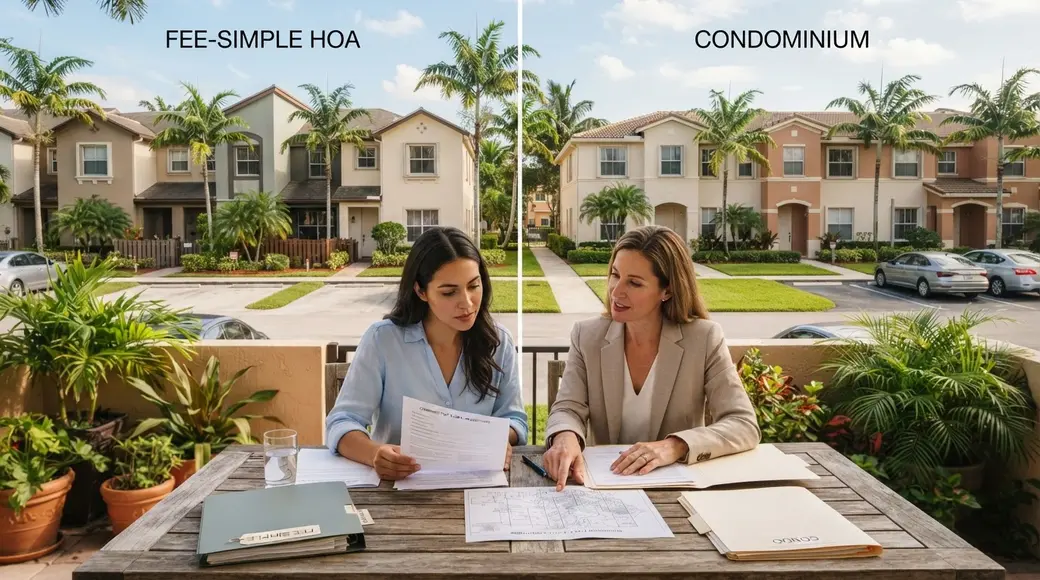
To tell whether a Miami townhouse is an individually deeded HOA townhouse or legally part of a condominium, check the property record, legal description, deed, recorded declaration, association documents, and title information.
Do not rely only on the word “townhouse” in an MLS listing or on real estate portals such as Zillow, Realtor.com, Redfin, or Homes.com. A property can look exactly like a townhouse and still be legally organized as a condominium.
The safest way to identify a Miami townhouse is to verify the legal ownership structure, not the architecture.
Why Does the Type of Townhouse Matter?
The ownership structure can affect:
- Who owns the land
- Who maintains the roof
- Who repairs the exterior
- What type of insurance you need
- Which expenses belong to the association
- Whether reserves are required
- Your exposure to special assessments
- Your responsibility for major repairs
- Which association laws and documents apply
- How much control you have over maintenance decisions
A townhouse with a $250 monthly HOA fee and a townhouse with a $700 condominium fee may look almost identical from the street while creating very different ownership responsibilities.
Before comparing the costs of two properties, first determine what you are actually buying.
Fee-Simple HOA Townhouse vs. Condominium Townhouse
For simplicity, this article uses “fee-simple townhouse” to describe an individually deeded townhouse parcel governed primarily through a homeowners association.
Technically, Florida condominium property can also involve fee-simple ownership. Florida law states that a condominium may be created on land owned in fee simple or held under a qualifying lease. A condominium itself is created by recording a declaration of condominium.
Here is the practical distinction buyers usually need to understand:
|
What to Check |
Individually Deeded HOA Townhouse |
Condominium Townhouse |
|
Legal structure |
Individual parcel in an HOA community |
Condominium unit |
|
Primary association framework |
Usually Chapter 720 HOA |
Chapter 718 condominium |
|
Governing document |
Declaration of covenants/restrictions |
Declaration of condominium |
|
Roof responsibility |
Often individual owner |
Often association, but verify |
|
Exterior responsibility |
Often individual owner |
Frequently association or shared |
|
Property insurance |
Often broader individual policy |
Usually association master policy plus individual unit coverage |
|
Reserves |
HOA-specific |
Condo reserve rules may apply |
|
Possible for shared HOA expenses |
Possible for condominium common expenses |
|
|
Milestone/SIRS exposure |
Not generally subject to condo SIRS rules |
May apply when statutory criteria are met |
|
Best verification |
Deed, legal description, title and HOA documents |
Deed, declaration, title and condo documents |
Important: SIRS requirements apply to qualifying condominium buildings under Florida law. Other inspection or building-safety requirements may still apply depending on the property, so buyers should verify the specific building and association requirements.
Never determine ownership type from appearance alone.
Step 1: Look Up the Property in Miami-Dade Records
Start with the Miami-Dade County Property Appraiser’s Property Search.
The county allows users to search properties and review key property characteristics. Each property has a 13-digit folio number, also called a parcel or property identification number.
Look for information such as:
- Owner
- Folio number
- Property address
- Legal description
- Property characteristics
- Sales history
- Associated condominium information when available
This is an excellent starting point, but do not treat the Property Appraiser page as the final legal determination.
Miami-Dade itself notes that Property Search information is maintained for tax-assessment purposes and may not always reflect the most current information.
Use the property record to start your investigation, not to end it.
Step 2: Read the Legal Description
The legal description can provide one of the strongest clues about ownership.
A condominium legal description will commonly identify a particular unit and reference the recorded condominium declaration.
An individually deeded townhouse parcel may instead reference:
- Lot
- Block
- Subdivision
- Plat
- Parcel
Do not worry if the description looks technical. You do not have to interpret it alone.
If you are unsure what the legal description means, ask your real estate professional, title company, or real estate attorney to help verify it.
The legal description is more important than whether a website calls the property a townhouse, condo, villa, or townhome.
Step 3: Find Out Which Type of Association Governs the Property
Ask a very simple question:
Is this property governed by a condominium association or a homeowners association?
Florida condominium associations operate under Chapter 718. The operation of a condominium is handled by its condominium association.
Homeowners associations generally operate under Chapter 720. Florida law requires an HOA operating a qualifying community to be incorporated, and its governing documents are recorded in the county where the community is located.
Miami-Dade also maintains a Community Association Registry that can be searched by address, folio number, community name, association type, and other information.
That resource can be especially useful when the community name or association type is unclear.
Step 4: Look for the Recorded Declaration
This is one of the most important steps.
A Florida condominium is legally created through a recorded Declaration of Condominium.
A homeowners association community instead generally has a recorded Declaration of Covenants, Conditions and Restrictions, often called the declaration or CC&Rs.
Miami-Dade’s Clerk of the Court and Comptroller provides an Official Records search where recorded documents can be searched by categories including name, document type, book and page information, date, and address.
If you find a document titled:
Declaration of Condominium
that is a strong indication that the property is legally part of a condominium.
If you find HOA covenants associated with an individually deeded or platted parcel rather than a condominium unit, you may be looking at the type of fee-simple HOA structure described in this article.
Again, a title professional can confirm the conclusion.
Step 5: Ask Who Owns and Maintains the Roof
This is one of the most practical questions buyers can ask:
Who is responsible for replacing the roof?
For an individually deeded townhouse, the individual owner is often responsible for the roof.
For a condominium townhouse, the association may be responsible for it.
But there are exceptions.
Do not use roof responsibility alone as proof of the ownership structure. Governing documents can allocate maintenance responsibilities in different ways.
Instead, use the answer to help you understand the financial consequences.
If the owner maintains the roof, ask:
- How old is it?
- Is it separately permitted?
- Is replacement the individual owner’s responsibility?
- Does the association restrict roofing materials or contractors?
- How will it affect the buyer’s insurance?
If the association maintains the roof, ask:
- Is replacement included in reserves?
- When was it last replaced?
- Is another project planned?
- Could an assessment be required?
Who pays for the roof can tell you a great deal about future expenses, even when it does not establish the legal structure by itself.
Step 6: Check Who Maintains the Exterior
Ask who is financially responsible for:
- Exterior walls
- Painting
- Windows
- Doors
- Driveway
- Fences
- Landscaping
- Structural components
- Plumbing outside the unit
- Shared walls
- Hurricane protection
An individually deeded townhouse owner may have considerably more personal responsibility for these items.
A condominium townhouse association may maintain some or most exterior building components.
The declaration and maintenance provisions should answer these questions.
This is why two townhouse communities with similar monthly fees can have very different true ownership costs.
Step 7: Review the Insurance Structure
Insurance can provide another useful clue.
A fee-simple townhouse owner commonly needs insurance covering the individual dwelling, subject to the exact ownership and HOA structure.
A condominium townhouse commonly has an association master policy covering certain condominium property, while the individual unit owner obtains separate coverage appropriate to the unit and personal exposures.
Do not assume the insurance arrangement from the building style.
Before making a final decision, ask:
- What does the association insure?
- What must the individual owner insure?
- Who insures the roof?
- Who carries windstorm coverage?
- What are the association deductibles?
- Could owners face an assessment after a major insured loss?
In South Florida, understanding the insurance responsibility is part of understanding the property’s true monthly and long-term cost.
Step 8: Do Not Rely Only on Zillow or Other Real Estate Portals
Zillow, Realtor.com, Redfin, Homes.com, and similar portals are useful tools for discovering homes.
They should not be your final source for determining legal ownership.
Online real estate platforms combine information from sources such as listing services, public records, county data, and other databases. Zillow states that some of its property information and valuation data incorporates MLS, public-record, and user-submitted information. Redfin says its public-property facts come through third-party providers using county assessor and recorder information.
Those platforms organize millions of properties into convenient consumer-facing categories. That convenience does not replace title or recorded-document review.
You may see:
Property type: Townhouse
and assume that means fee-simple ownership.
It does not necessarily mean that.
The property may still be a condominium townhouse.
Likewise, the HOA fee, maintenance responsibilities, association name, or other information displayed online may not tell the complete legal story.
Use real estate portals to find properties. Use recorded documents and professional verification to understand what you are buying.
Step 9: Ask for the Association Documents
Once you know an association exists, ask for the governing documents.
For a condominium townhouse, important documents may include:
- Declaration of condominium
- Articles of incorporation
- Bylaws
- Rules
- Current budget
- Financial statements
- Reserve information
- Recent meeting minutes
- Current assessments
- Association loans
- Insurance information
- Structural Integrity Reserve Study, when applicable
- Milestone inspection information, when applicable
For a fee-simple HOA townhouse, consider reviewing:
- Declaration of covenants
- Articles
- Bylaws
- Rules
- Current budget
- Financial reports
- Reserve information
- Assessments
- Meeting minutes
- Common-area insurance
- Maintenance responsibilities
Miami-Dade’s Community Association Registry requires registered community associations to provide specified governing documents and certain other information, which can provide another useful research point.
Step 10: Have the Ownership Structure Professionally Confirmed
You do not need to become an expert in deeds, plats, declarations, and Florida association law to buy a townhouse.
You do need to ask the question.
Before making a final decision, verify the property through:
- Deed
- Title information
- Legal description
- Recorded declaration
- Association documents
- Miami-Dade property records
- Miami-Dade official records
If the ownership structure is unclear, ask a knowledgeable real estate professional or title company to help identify what you are actually buying and which documents deserve closer review.
A Florida real estate attorney can provide legal advice when the documents or ownership rights require legal interpretation.
The goal is not to interpret every document yourself. The goal is to make sure someone verifies the answer before you close.
Five Clues That Are Helpful, But Do Not Prove It
Buyers often try to determine ownership using visual or financial clues.
These clues can help, but none of them is definitive.
1. “The HOA fee is very low.”
That may suggest an individually maintained townhouse, but it does not prove it.
2. “Each owner has a separate roof.”
That may suggest fee-simple responsibility, but the declaration still controls.
3. “There are no neighbors above or below.”
Condominium townhouses can have private entrances and no vertical neighbors.
4. “It has a private backyard.”
Outdoor space does not determine the legal ownership structure.
5. “Zillow calls it a townhouse.”
That describes how the property is categorized on the portal. It does not substitute for the deed and governing documents.
Architecture provides clues. Legal records provide answers.
Why Can Two Townhouses That Look Identical Have Different Financial Risks?
Consider two hypothetical Miami townhouses.
|
Responsibility |
Townhouse A |
Townhouse B |
|
Appearance |
Two-story townhouse |
Two-story townhouse |
|
Legal structure |
HOA parcel |
Condominium unit |
|
Monthly fee |
$250 |
$575 |
|
Roof |
Individual owner |
Association |
|
Exterior painting |
Owner |
Association |
|
Building insurance |
Primarily owner |
Master policy plus unit coverage |
|
Common-area reserves |
Limited HOA needs |
Condo reserves |
|
Special-assessment exposure |
HOA common areas |
Common building and association expenses |
|
Owner control over roof contractor |
Greater |
Usually association-controlled |
Neither structure is automatically better.
Townhouse A gives the owner more individual control, but that owner must prepare for a future roof replacement and other property expenses.
Townhouse B may have a higher monthly fee because the association handles more exterior expenses, but the buyer becomes more financially dependent on the association’s budgeting and decision-making.
The real question is not which townhouse has the lower fee. It is which responsibilities come with that fee.
What If the Listing and Property Records Disagree?
Do not guess.
If the MLS says townhouse, the portal says condo, and the tax record appears different again, stop and verify before relying on any classification.
Ask your agent and title company to review:
- The deed
- The legal description
- The recorded declaration
- The plat or condominium documents
- The association information
A discrepancy does not automatically mean there is a problem. Different systems may use different property classifications.
It does mean that you need a clear answer before making financial assumptions.
Why Does This Matter Before Making an Offer?
Imagine budgeting for a townhouse because you believe the individual owner controls the roof.
After reviewing the documents, you discover it is a condominium and the association is responsible for the roofs.
That may sound like good news until you also discover:
- The roofs are nearing replacement
- Reserves are insufficient
- A project is being discussed
- An association loan may be considered
The opposite can happen too.
You may assume that the HOA fee covers exterior maintenance, only to discover that you personally own and maintain the roof, walls, windows, and driveway.
Both situations affect how much money you should keep available after closing.
Ownership structure changes where the financial responsibility sits.
A Quick Townhouse Verification Checklist
Before buying a Miami townhouse, try to answer these questions:
Ownership
- Is it an individually deeded HOA parcel or condominium unit?
- What does the legal description say?
- Is there a Declaration of Condominium?
- Which association governs it?
Maintenance
- Who replaces the roof?
- Who maintains exterior walls?
- Who paints the building?
- Who replaces windows and doors?
- Who maintains landscaping?
- Who handles structural repairs?
Insurance
- What does the association insure?
- What does the individual owner insure?
- Are there large deductibles?
Financial obligations
- What does the monthly fee cover?
- Are reserves maintained?
- Are there current assessments?
- Is an association loan outstanding?
- Are major repairs planned?
Verification
- Did you review the Miami-Dade property record?
- Were recorded documents checked?
- Did you receive the association documents?
- Has your real estate professional or title company confirmed the ownership structure?
If several answers remain unclear, keep investigating before your contractual review deadlines expire.
The Bottom Line
A Miami townhouse can look like a house and still legally be a condominium.
Do not rely only on the listing description, the monthly fee, the architecture, or a label on Zillow or another real estate portal.
Verify the deed, legal description, recorded declaration, association type, title information, maintenance responsibilities, and insurance structure.
An individually deeded HOA townhouse may give you more direct control over repairs while making you personally responsible for more of the property.
A condominium townhouse may provide more association-managed maintenance while exposing you to shared budgets, reserves, assessments, insurance expenses, and association decisions.
Neither is automatically better.
The better choice is the one where you understand what you own, what you share, what you control, and what you may have to pay for.
If you are considering a Miami townhouse and the ownership structure is not clear, I can help you gather the available property and association information and identify the questions that should be answered. When title or legal verification is needed, the appropriate title or legal professional can help confirm the details before you make your final decision.
Frequently Asked Questions
How can I tell if a Miami townhouse is fee simple or a condo?
Check the deed, legal description, title information, recorded declaration, association documents, and Miami-Dade property records. A title company or knowledgeable real estate professional can also help verify the ownership structure.
Can a townhouse legally be a condominium in Florida?
Yes. “Townhouse” usually describes the physical design of a property. A townhouse-style home can legally be a condominium unit.
Does Zillow tell me whether a townhouse is fee simple?
Do not rely on Zillow or another real estate portal as the final legal determination. Portal property categories are useful for home searches, but ownership should be verified through recorded documents, title information, and association records.
What does “fee-simple townhouse” mean?
In common real estate usage, it usually describes a townhouse where the buyer owns an individually deeded parcel rather than a condominium unit. Technically, condominium interests can also involve fee-simple ownership, so buyers should verify the recorded legal structure.
Does a low HOA fee mean a townhouse is fee simple?
No. A lower fee may be a clue that individual owners maintain more of their property, but the amount of the association fee does not determine legal ownership.
Who owns the roof on a fee-simple townhouse?
The individual owner often maintains the roof, but this depends on the community’s governing documents. Never assume roof responsibility without checking.
Who owns the roof on a condominium townhouse?
The condominium association may maintain the roof as part of the condominium property, but responsibility depends on the declaration and unit boundaries.
Does a condominium townhouse require a SIRS?
Not necessarily. Florida's Structural Integrity Reserve Study requirements generally apply to residential condominium buildings that are three or more habitable stories in height and meet the statutory criteria. A townhouse-style appearance by itself does not determine whether a SIRS is required.
Can a fee-simple townhouse still have an HOA and special assessments?
Yes. An HOA can collect regular assessments and may levy other authorized assessments for community expenses according to its governing documents and applicable law.
Where can I look up a Miami townhouse?
Start with the Miami-Dade Property Appraiser Property Search. Buyers can also search Miami-Dade Official Records and the county’s Community Association Registry when applicable.
Should a title company confirm whether my townhouse is a condo?
A title company can help verify ownership and title information as part of the transaction. When interpretation of legal rights or documents is required, consult a Florida real estate attorney.
Is a fee-simple townhouse better than a condominium townhouse?
Not automatically. Fee-simple ownership may offer more individual control but more personal maintenance responsibility. A condominium townhouse may reduce some individual maintenance while creating greater shared financial responsibility.
Recent Posts









GET MORE INFORMATION