
CDD Fees and Non-Ad Valorem Assessments in Miami-Dade: What Homeowners and Buyers Should Know
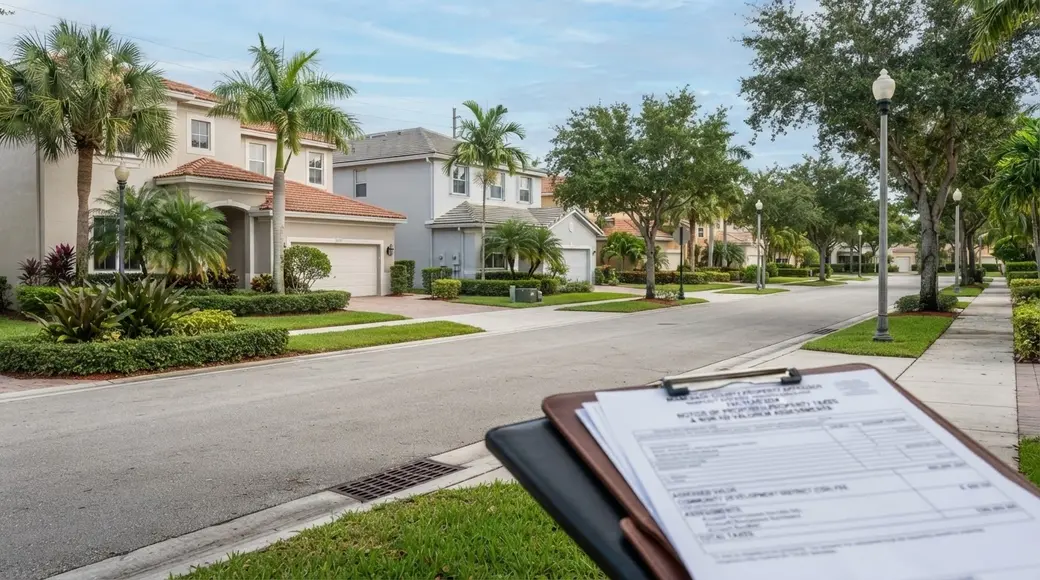
Not every charge on a Miami-Dade property-tax bill is based on the value of your home.
Non-ad valorem assessments are charges imposed for specific services or benefits rather than calculated from property value or a millage rate. In Miami-Dade, they can include solid waste, street lighting, security, landscaping, capital improvements, and Community Development District, or CDD, assessments. The Miami-Dade Property Appraiser lists these charges separately from value-based property taxes. (Miami-Dade County)
For buyers, these charges matter because two homes with similar prices and taxable values can still have different total annual bills.
Key Takeaways
- Ad valorem taxes are based on taxable property value and millage rates.
- Non-ad valorem assessments are generally based on a specific service or benefit rather than property value.
- Miami-Dade examples include solid waste, street lighting, landscaping, security, capital improvements, and certain CDD assessments.
- A Community Development District is a governmental special district, not an HOA.
- A property can be subject to both an HOA fee and a CDD assessment.
- Homestead Exemption and Save Our Homes affect property-value calculations, but they do not directly reduce charges that are not based on taxable value.
- Some non-ad valorem assessments appear on the annual property-tax bill.
- CDD assessments can help finance infrastructure and ongoing district services.
- CDD assessment amounts and other special assessments can change over time.
- Buyers should review the specific property's tax record, district information, and disclosures before purchasing.
- New subdivisions require extra attention because some assessments may not yet appear in an online estimate.
What Is a Non-Ad Valorem Assessment?
A non-ad valorem assessment is a charge that is not calculated using a property's taxable value and millage rate.
Florida Statute 197.3632 defines a non-ad valorem assessment as an assessment that is not based upon millage and that may be collected through the property-tax system. Florida law provides a uniform method for local governments and special districts to levy and collect these assessments. (Online Sunshine)
Miami-Dade gives an even more practical definition: a non-ad valorem assessment is a charge used to cover a specific service benefiting certain properties. Unlike ordinary property taxes, the charge is based on the benefit or service rather than the property's market value. Miami-Dade lists services such as garbage collection, street lighting, security guards, landscaping, and water or sewer improvements. (Miami-Dade County)
That difference is important.
If your home increases in value, a non-ad valorem charge does not automatically increase simply because the home's market value increased.
Likewise, lowering taxable value does not necessarily lower that separate assessment.
What Is the Difference Between Ad Valorem and Non-Ad Valorem Charges?
The easiest way to understand the distinction is to compare how each one is calculated.
|
Feature |
Ad Valorem Tax |
Non-Ad Valorem Assessment |
|
Based on property value? |
Yes |
Generally no |
|
Uses taxable value? |
Yes |
Generally no |
|
Uses millage rates? |
Yes |
No |
|
Homestead affects calculation? |
It can |
Not directly through taxable value |
|
Save Our Homes affects calculation? |
It can affect assessed value |
Not directly |
|
May appear on annual tax bill? |
Yes |
Yes, when collected through the tax bill |
|
Examples |
County, school, municipal taxes |
Garbage, lighting, security, CDD assessments |
Miami-Dade explains that non-ad valorem assessments can appear on the same annual property-tax statement even though they are not calculated from property value. (Miami-Dade County)
That is why the phrase “property-tax bill” can sometimes be confusing. The bill may include both traditional property taxes and other assessments.
If you want the larger property-tax calculation explained first, see my guide to how to estimate Miami-Dade property taxes before buying.
What Is a Community Development District, or CDD?
A Community Development District, or CDD, is a Florida special district that can help manage and finance infrastructure and community services for a defined area.
Florida Chapter 190 authorizes CDDs as an alternative method for managing and financing community-development services and infrastructure. Florida law recognizes CDDs as governmental special districts created under the Uniform Community Development District Act. (Online Sunshine)
Depending on the district, CDD-supported facilities or services can involve infrastructure such as roads, drainage, water-management systems, utilities, recreational facilities, landscaping, or other authorized community improvements.
A CDD can finance certain improvements through bonds and recover costs through taxes, assessments, fees, or charges authorized by law.
Florida law specifically permits CDD boards to levy special assessments for the construction, reconstruction, acquisition, or maintenance of district facilities. Those assessments may be structured in annual installments, subject to the statute. (Online Sunshine)
Is a CDD the Same Thing as an HOA?
No. A CDD and a homeowners' association, or HOA, are legally different entities.
Florida law defines a homeowners' association as a Florida corporation operating a residential community and expressly states that the term does not include a community development district or similar special taxing district. That distinction appears directly in Florida Statute 720.301. (Online Sunshine)
A community can have:
- an HOA,
- a CDD,
- both an HOA and a CDD, or
- neither.
The two can also pay for different things.
An HOA typically operates under recorded community covenants and collects association assessments.
A CDD is a governmental special district operating under Florida law.
That distinction is important when comparing homes because an advertised HOA fee may not tell you whether the property also has a CDD or another non-ad valorem assessment.
What Can a CDD Assessment Pay For?
CDD assessments can help fund capital infrastructure and ongoing district operations authorized under Florida law.
For example, a district may be involved in financing or maintaining certain:
- roadways,
- drainage and stormwater systems,
- water-management facilities,
- utility infrastructure,
- landscaping,
- recreation facilities,
- community facilities, or
- other public improvements authorized by Chapter 190.
The exact services vary by district.
Florida law requires CDDs to disclose information relating to the public financing and maintenance of district improvements to existing and prospective residents. The district must make financing disclosure information available and file required disclosure documents in county property records. (Online Sunshine)
That means buyers should investigate the specific district rather than assume that every CDD works the same way.
Why Can a CDD Charge Have More Than One Component?
A CDD bill can sometimes involve different types of costs.
One portion may relate to debt service, which helps repay financing used for district infrastructure.
Another portion may relate to operations and maintenance, often called O&M, which supports ongoing district expenses.
The structure varies by district, so buyers should not assume that every CDD has identical charges or that a CDD assessment will remain exactly the same every year.
Florida law allows CDDs to issue bonds and levy special assessments for authorized improvements. The district's governing board also adopts budgets and assessment levels according to applicable law. (Online Sunshine)
For a specific property, the important questions are:
- What assessment applies to this parcel?
- What portion is debt-related?
- What portion funds annual operations?
- Is there outstanding district debt?
- How long is any capital assessment scheduled to continue?
- Can the operating assessment change?
Those answers should come from the specific CDD's official records.
Can CDD Assessments Last for Many Years?
Yes, some CDD capital assessments can extend over a long period.
Florida Statute 190.022 states that district special assessments may be made payable in no more than 30 yearly installments. That does not mean every CDD assessment lasts 30 years, but Florida law allows that maximum installment structure for qualifying district assessments. (Online Sunshine)
This is why buyers should verify the actual remaining obligation on the specific property rather than relying on a general statement such as “CDD fees last 30 years.”
Some components may end when debt is repaid.
Other operating or maintenance assessments can continue because the district continues providing services.
The district's official budget, bond documents, and assessment information provide the most reliable answers.
Where Do CDD and Other Non-Ad Valorem Assessments Appear?
Many non-ad valorem assessments are collected on the annual property-tax bill.
Miami-Dade states that non-ad valorem special assessments are billed annually on the property-tax statement and collected by the County Tax Collector. The county's Special Assessment Districts page explains this collection process. (miamidade.gov)
When reviewing the annual tax bill, look specifically for the section labeled “Non-Ad Valorem Assessments.” That is where property-specific charges collected through the tax bill are generally listed separately from value-based property taxes.
The Florida Department of Revenue also requires tax collectors to report non-ad valorem assessments collected on the Notice of Taxes. Those reports identify the assessments included on the property-tax bill.
However, not every possible charge is necessarily collected through the tax bill.
That is another reason buyers should review both the property's tax record and the applicable district's records.
What Happens If a Non-Ad Valorem Assessment Goes Unpaid?
A non-ad valorem assessment collected through the annual property-tax bill should not be treated as an optional community charge.
If the property taxes and assessments on the bill become delinquent, Florida's tax-collection process can apply.
Under Florida law, a tax certificate can represent unpaid delinquent real-property taxes and non-ad valorem assessments, together with interest, costs, and related charges. The tax certificate becomes a lien against the specific parcel. Florida Statute 197.102 explains the legal effect of a tax certificate. (Online Sunshine)
Florida law also provides for the sale of tax certificates on real property when taxes have not been paid. Florida Statute 197.432 governs that process. (Online Sunshine)
Miami-Dade likewise explains that when property taxes or assessments are not paid by the statutory due date, a tax certificate may be issued and a tax lien may be placed on the property for the delinquent amount. The County discusses this directly in its Special Assessment Districts guidance. (Miami-Dade County)
For homeowners, the practical takeaway is simple: if a non-ad valorem assessment appears on the tax bill, it should be reviewed and paid with the same care as the other amounts due on that bill.
What Types of Non-Ad Valorem Assessments Exist in Miami-Dade?
Miami-Dade currently administers a large number of special assessment districts.
Miami-Dade administers more than 1,000 active special assessment districts across municipal and unincorporated areas. These districts can provide services such as street lighting, security guards, guardhouses, maintenance, and capital improvements. Miami-Dade's Special Assessment Districts system provides information on these districts.
Common examples of non-ad valorem charges include:
- solid waste collection,
- street lighting,
- security guard services,
- landscaping,
- lake maintenance,
- road or capital improvements,
- water or sewer improvements, and
- Community Development District assessments.
Miami-Dade's current non-ad valorem listings also identify individual CDDs operating within the county.
The exact assessment depends on the property.
Does Homestead Exemption Reduce a CDD or Non-Ad Valorem Assessment?
Generally, not through the ordinary Homestead taxable-value calculation.
Homestead Exemption reduces taxable value for applicable ad valorem property taxes.
A non-ad valorem assessment, by definition, is not calculated from millage or taxable value. Therefore, reducing taxable value through Homestead Exemption does not directly reduce a charge calculated on some other basis. (Online Sunshine)
This is an important distinction for longtime homeowners.
You may see substantial benefits from Miami-Dade Homestead Exemption on the value-based portion of your property taxes while still paying the full amount of a separate non-ad valorem assessment applicable to the property.
The exact assessment methodology can vary by district, so property-specific rules should always be checked.
Does Save Our Homes Reduce CDD Fees?
Save Our Homes does not directly cap a non-ad valorem assessment because Save Our Homes limits assessed-value growth, not separate service or benefit assessments.
Florida's Save Our Homes limitation can keep assessed value below market value for a qualifying homestead.
But if the assessment is not based on assessed value, that lower assessed value does not automatically reduce the separate charge.
This is one reason your total tax bill can increase even when your Save Our Homes assessed-value increase remains limited.
For the distinction between assessed value and the final bill, see Save Our Homes Explained for Miami-Dade Homeowners.
Can Non-Ad Valorem Assessments Change From Year to Year?
Yes.
The amount of a non-ad valorem assessment can change based on the cost of providing the service, district budgets, capital needs, assessment methodology, or other governing decisions.
Miami-Dade's 2026 guidance for special taxing districts explains that property owners can receive notice when a proposed non-ad valorem assessment is increasing. The county identifies services such as security, street lighting, landscaping, lake maintenance, and capital improvements among the costs these assessments may support. (Miami-Dade County)
So a stable property value does not guarantee that every charge on the annual tax bill will remain stable.
This is another reason homeowners should review their annual tax documents rather than focusing only on market value.
Are CDD Fees Included in Miami-Dade's Property Tax Estimator?
They can be, but buyers should verify.
The Miami-Dade Property Appraiser's Tax Estimator states that non-ad valorem assessments are included in the estimate only when the government imposing them has arranged for collection through the Miami-Dade Tax Collector on the annual real-property tax bill. (Miami-Dade County)
Miami-Dade also gives an important warning for new communities:
New subdivisions or parcels may be subject to non-ad valorem assessments that are not yet reflected in the estimator. (Miami-Dade County)
That warning is particularly important for buyers considering new construction.
The estimator is useful, but it is not a substitute for asking what assessments apply to the specific property.
Why Should New-Construction Buyers Pay Extra Attention?
New construction can create timing issues.
A parcel may not yet have a complete assessment history.
A newly created district may still be developing its assessment roll.
A property-tax estimator may not yet show every non-ad valorem assessment affecting a new subdivision.
Miami-Dade specifically cautions that new subdivisions or parcels may carry non-ad valorem assessments that are not reflected in its online estimate. (Miami-Dade County)
Florida law also requires a specific disclosure in contracts for the initial sale of property within a CDD. The disclosure states that the district may impose taxes or assessments that are in addition to county and other local-government taxes and assessments. Florida Statute 190.048 sets out that required disclosure. (Online Sunshine)
If you are buying new construction, read the CDD and financing disclosures rather than relying solely on the advertised monthly payment.
How Can a Buyer Check Whether a Miami-Dade Property Has a CDD or Other Assessment?
A good pre-purchase review has several steps.
Step 1: Check the Miami-Dade property-tax record
Look at the current tax information for the specific folio.
Review any listed non-ad valorem assessments.
Step 2: Use the official Miami-Dade Tax Estimator
The Property Appraiser's Tax Estimator can show certain non-ad valorem charges collected through the annual tax bill.
Do not assume it captures every future assessment, particularly for new subdivisions. (Miami-Dade County)
Step 3: Identify the district
If a CDD name appears, search for that specific district.
FloridaCommerce maintains the state's Official List of Special Districts, including district names, status, county, and official websites. (Florida Jobs)
Step 4: Review the CDD's official records
Look for:
- current budget,
- assessment schedule,
- bond information,
- debt-service information,
- operations and maintenance assessments,
- meeting records, and
- contact information.
Step 5: Read your contract and disclosures
For an initial sale within a CDD, Florida law requires a conspicuous CDD disclosure in the contract. (Online Sunshine)
For resale properties, ask directly whether the property is located within a CDD or another assessment district and verify through official records.
Step 6: Compare the charge with your total ownership budget
A CDD assessment should be considered alongside:
- mortgage payment,
- property taxes,
- homeowners insurance,
- flood insurance when applicable,
- HOA or condo fees,
- special assessments,
- utilities, and
- maintenance.
A lower purchase price does not necessarily mean a lower total annual ownership cost.
Can Two Similar Miami-Dade Homes Have Different Total Tax Bills Because of Non-Ad Valorem Assessments?
Yes.
Suppose two homes have:
- similar market values,
- similar assessed values,
- similar Homestead status, and
- the same general millage rates.
One property may nevertheless have additional assessments for a CDD, security district, street-lighting district, or other service.
That home can therefore have a higher total annual amount due even though its value-based property taxes are similar.
This is why buyers should compare more than the headline tax amount.
For a complete explanation of the post-purchase tax calculation, see Why Property Taxes Go Up After Buying a Miami Home.
What Is the Difference Between a CDD Assessment and a Special Assessment District?
They are related concepts, but they are not automatically the same thing.
A CDD is a particular type of Florida special district governed primarily by Chapter 190.
Miami-Dade also administers local special assessment districts for services such as lighting, guards, maintenance, and capital improvements.
Both can generate non-ad valorem assessments, but they arise under different legal and governmental structures.
This is why the description on the bill matters.
Do not assume every non-ad valorem assessment is a CDD.
Can You Pay Off a CDD Assessment Early?
Sometimes a property may have a capital or debt assessment that can be prepaid, but that depends on the specific district's financing documents and assessment structure.
Even if a debt-related assessment is prepaid, annual operations and maintenance assessments may continue.
Therefore, buyers should not assume that “paying off the CDD” necessarily eliminates every future district charge.
The correct source is the specific CDD's official administrator, assessment records, and bond documents.
What Happens to an Outstanding Assessment When the Property Is Sold?
An outstanding non-ad valorem assessment does not automatically mean that the entire remaining assessment balance must be paid simply because the property is sold.
Miami-Dade explains that non-ad valorem assessments are assigned to the property rather than to an individual owner. The current owner is responsible for amounts that are due, but as a general rule, the County does not require all outstanding assessments to be paid in full before a property sale. Miami-Dade states that outstanding assessments are often handled as a negotiated settlement matter between buyer and seller. (Miami-Dade County)
What happens at closing can depend on:
- the specific assessment and its terms,
- whether an installment is currently due,
- whether the assessment is delinquent,
- the purchase contract,
- negotiations between buyer and seller,
- title and closing requirements, and
- lender requirements.
There is an important exception for delinquent amounts.
Miami-Dade states that when unpaid property taxes or assessments have resulted in a tax certificate or tax lien, the delinquent debt must be satisfied in connection with the property sale. (miamidade.gov)
For CDD assessments, the underlying financing structure also matters. A property may continue to have future annual installments associated with district debt according to the district’s financing and assessment schedule after ownership changes.
Practical takeaway: Buyers and sellers should confirm the exact assessment status with the district, title or closing professional, and lender rather than assuming either that the full balance must be paid or that every obligation simply disappears at closing.
What Should Homeowners Check on Their TRIM Notice?
Your Miami-Dade TRIM Notice can help you identify proposed taxes and certain non-ad valorem assessments before the final tax bill is issued.
When reviewing it, separate the questions:
For ad valorem taxes:
Did market value, assessed value, taxable value, exemptions, or millage rates change?
For non-ad valorem assessments:
Did a CDD, garbage, lighting, security, maintenance, or other assessment change?
Because the calculations are different, a higher non-ad valorem charge should not automatically be blamed on a higher property value.
My guide to the Miami-Dade TRIM Notice explains how to review those sections.
Common Misunderstandings About CDD and Non-Ad Valorem Assessments
Myth: A CDD is just another HOA fee.
Reality: A CDD is a governmental special district. Florida law expressly distinguishes CDDs from homeowners' associations. (Online Sunshine)
Myth: Homestead Exemption reduces everything on my property-tax bill.
Reality: Homestead affects taxable value for applicable ad valorem taxes. A non-ad valorem charge is not calculated from that taxable value.
Myth: Save Our Homes caps CDD increases.
Reality: Save Our Homes limits qualifying assessed-value growth. It does not directly cap a separate assessment that is not based on assessed value.
Myth: Every CDD assessment lasts 30 years.
Reality: Florida law allows certain district assessments to be payable over as many as 30 annual installments, but the actual term depends on the district and financing. (Online Sunshine)
Myth: If the online tax estimator does not show a CDD, there cannot be one.
Reality: Miami-Dade specifically warns that new subdivisions or parcels may have non-ad valorem assessments not yet reflected in the estimator. (Miami-Dade County)
Myth: Every non-ad valorem assessment is a CDD.
Reality: Miami-Dade has many other special assessment districts for services such as lighting, security, landscaping, waste collection, and capital improvements. (Miami-Dade County)
A Practical Buyer Checklist
Before buying a Miami-Dade property, ask:
- Does the property currently have any non-ad valorem assessments?
- Is it located within a Community Development District?
- What is the current annual CDD assessment?
- Does the CDD assessment include debt service, operations and maintenance, or both?
- Is there outstanding district debt associated with the parcel?
- How long is the current debt assessment scheduled to continue?
- Can the operating assessment change annually?
- Are there HOA or condo fees in addition to the CDD?
- Are there other special taxing or assessment districts?
- Does the current tax record reflect all expected charges?
- Is the property new construction or in a newly developed subdivision?
- Are there district disclosures, budgets, or bond documents that should be reviewed?
The goal is not to avoid a property simply because it has a CDD or another assessment.
The goal is to understand the full recurring cost of ownership before you buy.
Bottom Line
CDD fees and non-ad valorem assessments are part of the real cost of owning some Miami-Dade properties, but they are different from ordinary value-based property taxes.
A non-ad valorem assessment pays for a specific service or benefit and is generally not calculated from taxable property value.
A CDD is a governmental special district that can finance and maintain community infrastructure and services. Its assessments may appear on the same annual property-tax bill as county, school, and municipal taxes, but the calculation is different.
For homeowners, this explains why the total amount due can change even when Save Our Homes limits assessed-value growth.
For buyers, the lesson is simple:
Do not evaluate a property's annual tax cost by looking only at market value, Homestead, or millage rates. Check the non-ad valorem section too.
And if you are buying in a newer development, verify the CDD and other assessments directly because Miami-Dade warns that some new-parcel assessments may not yet appear in the online estimator.
This article is for general educational purposes and is not legal, tax, financial, or accounting advice. Property-specific CDD obligations, assessments, liens, financing terms, and payoff options should be verified through the applicable government agency, district, closing professional, or qualified adviser.
Frequently Asked Questions
What is a non-ad valorem assessment in Miami-Dade?
A non-ad valorem assessment is a property charge that is not calculated from taxable value or a millage rate. Miami-Dade uses these assessments to fund specific services or benefits such as solid waste, lighting, security, landscaping, capital improvements, and certain Community Development District services.
What is a CDD in Florida?
A Community Development District, or CDD, is a governmental special district authorized under Florida Chapter 190 to help manage and finance infrastructure and community services within a defined area.
Is a CDD the same as an HOA?
No. A CDD is a governmental special district, while an HOA is generally a private Florida corporation governed by community documents. Florida Statute 720.301 expressly states that a homeowners' association does not include a Community Development District.
Do Homestead Exemption and Save Our Homes reduce CDD fees?
Not directly when the CDD charge is a non-ad valorem assessment. Homestead Exemption and Save Our Homes affect taxable or assessed property value, while a non-ad valorem assessment is not based on millage or taxable value.
Are CDD fees included on the Miami-Dade property-tax bill?
Many CDD assessments are collected on the annual property-tax bill as non-ad valorem assessments. However, buyers should verify the specific property because not every possible charge is necessarily collected or displayed in the same way.
How long do CDD assessments last?
The term depends on the specific district. Florida law allows certain CDD special assessments to be payable in as many as 30 annual installments, but not every CDD assessment lasts 30 years. Operations and maintenance assessments may continue after debt-related assessments end.
Can CDD fees increase?
Yes. Operations, maintenance, service costs, budgets, or other district needs can cause assessment amounts to change. Debt-service assessments may follow a different schedule.
How can I find out whether a Miami-Dade property has a CDD?
Review the property's Miami-Dade tax record and non-ad valorem assessments, identify any listed district, and verify the district through official records. FloridaCommerce also maintains an Official List of Special Districts.
Can a property have both an HOA and a CDD?
Yes. A property can be subject to an HOA assessment and a separate CDD assessment because the HOA and CDD are different entities.
Why might a new-construction property not show its full CDD cost yet?
Miami-Dade warns that new subdivisions or parcels may be subject to non-ad valorem assessments that are not yet reflected in the Property Appraiser's online tax estimate. Buyers should review the project's official district and closing disclosures.
What happens if I do not pay a non-ad valorem assessment on my property-tax bill?
If a non-ad valorem assessment collected through the property-tax bill becomes delinquent, Florida's tax-certificate process can apply. A tax certificate can include unpaid non-ad valorem assessments and can become a lien against the property.
Recent Posts








GET MORE INFORMATION