
Florida Amendment 3 Explained: What the Proposed Homestead Property Tax Changes Mean for 2027
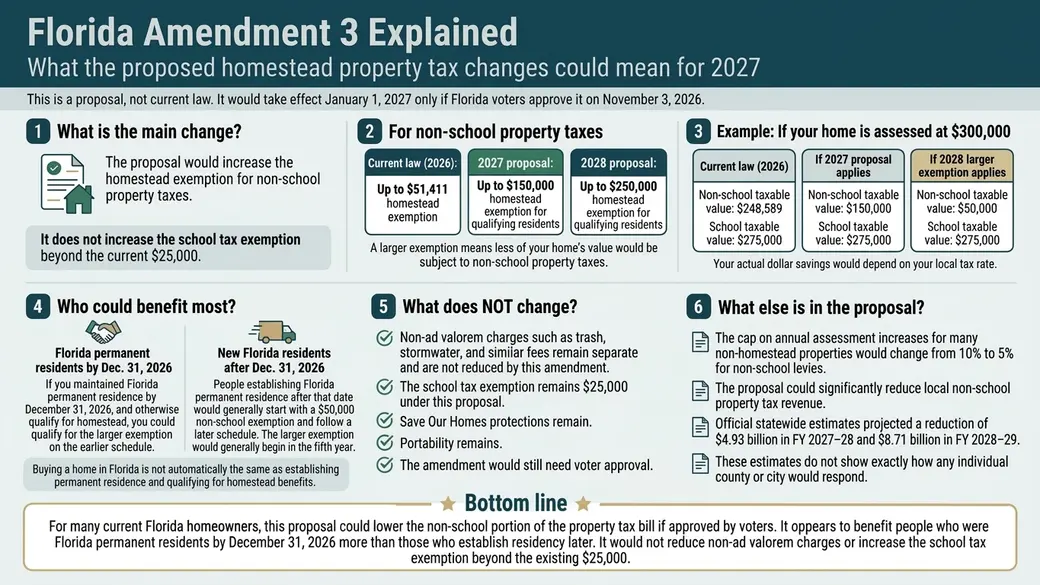
Florida Amendment 3 is a proposed constitutional amendment on the November 3, 2026 general-election ballot that would increase Florida's homestead exemption for property taxes other than school district taxes, reduce the annual assessment-growth cap on many non-homestead properties from 10% to 5%, and make additional changes affecting local property-tax rules.
It is not current law.
If at least 60% of Florida voters voting on Amendment 3 approve it, the principal changes would take effect on January 1, 2027. (Constitutional Initiatives)
The Florida Department of State lists it as Ballot Amendment 3 under the official title “Increased Homestead Exemption; Lower Cap on Increases in Non-Homestead Property Assessments.” View Florida Amendment 3 in the official Department of State database
For Miami-Dade homeowners, buyers, landlords, and other property owners, the proposal is worth understanding carefully because it contains several separate changes. It is not simply a vote on whether to increase the Homestead Exemption.
Key Takeaways
- Amendment 3 is a proposed Florida constitutional amendment, not current law.
- It will appear on the November 3, 2026 general-election ballot as Amendment 3.
- It requires at least 60% voter approval to pass.
- If approved, most provisions would take effect January 1, 2027.
- For qualifying people who maintained Florida permanent residence by December 31, 2026, the proposed non-school homestead exemption would rise to as much as $150,000 in 2027 and $250,000 in 2028.
- School district taxes would continue to receive only the $25,000 homestead exemption under the proposed constitutional language.
- The $250,000 non-school exemption would begin receiving positive inflation adjustments in 2029.
- People who did not maintain Florida permanent residence as of December 31, 2026 would be treated differently under the proposal.
- The annual assessment-growth cap on many non-homestead properties would fall from 10% to 5% for non-school levies.
- Save Our Homes would remain in place.
- Florida homestead portability would remain in place.
- CDD fees and other non-ad valorem assessments would not simply disappear because of the larger homestead exemption.
- The proposal would also change rules governing county and municipal use of ad valorem property-tax revenue.
What Exactly Is Florida Amendment 3?
Florida Amendment 3 originated as CS/HJR 1-F during Florida's 2026 special legislative session.
The Florida Legislature approved the joint resolution on June 2, 2026, with a 75-26 vote in the House and 30-9 vote in the Senate. It was signed by legislative officers and filed with the Secretary of State on June 16, 2026. (Florida Senate)
Because it proposes changes to the Florida Constitution, legislative approval did not make those changes law.
The amendment must now be approved by Florida voters.
Article XI, Section 5 of the Florida Constitution requires at least 60% of voters voting on a constitutional amendment to approve it before it can take effect. (Online Sunshine)
The proposal would amend portions of Article VII, Sections 4, 6, and 9, plus Article XII of the Florida Constitution. (Florida Senate)
In practical terms, those changes concern:
- Homestead exemptions.
- Assessment limits on non-homestead property.
- How counties and municipalities may use certain property-tax revenue.
- Procedures that could allow larger future exemptions.
What Would Amendment 3 Change About the Homestead Exemption?
The largest homeowner-facing change is the proposed increase in the exemption from non-school ad valorem property taxes.
For a qualifying person who maintained Florida permanent residence as of December 31, 2026, the proposed exemption would be:
|
Tax year |
Proposed exemption for non-school levies |
|
2027 |
Up to $150,000 of assessed value |
|
2028 |
Up to $250,000 of assessed value |
|
2029 onward |
$250,000 amount adjusted for positive inflation |
That schedule appears directly in the enrolled constitutional text and the Florida Senate's official summary. (Florida Senate)
This would represent a significant change from the current structure.
For the 2026 tax roll, Florida currently provides a first $25,000 homestead exemption that applies to school, county, and municipal taxes. Florida's additional non-school exemption is inflation-adjusted and equals $26,411 for 2026. (Florida Department of Revenue)
For a detailed explanation of today's system, see my Miami-Dade Homestead Exemption guide.
Would the $250,000 Exemption Apply to School Property Taxes?
No.
This is one of the most important parts of the proposal to understand.
The enrolled amendment keeps the school-district homestead exemption at up to $25,000 of assessed value.
The proposed $150,000 exemption in 2027 and $250,000 exemption in 2028 would apply to levies other than school district levies. (Florida Senate)
So Amendment 3 would not make the first $250,000 of a homestead exempt from every property tax.
Simple example
Suppose a qualifying homestead had an assessed value of $200,000 in 2028.
Under the proposed constitutional structure:
- Up to $200,000 could potentially be exempt from applicable non-school ad valorem levies, because the proposed exemption would be as much as $250,000.
- Only the first $25,000 would remain exempt from school district ad valorem taxes under this part of the constitution.
This example illustrates the exemption structure only. It is not a tax estimate because actual taxes depend on applicable taxable values, taxing authorities, rates, and other exemptions.
Would Everyone Receive the Same $250,000 Exemption?
No.
The proposal creates an important distinction based on Florida permanent-residency timing.
People who maintained Florida permanent residence as of December 31, 2026, and establish a qualifying homestead, would fall under the larger exemption schedule.
A person who had not maintained permanent residence in Florida by December 31, 2026 would generally receive up to a $50,000 non-school exemption after establishing homestead under the proposed system. That amount would begin adjusting for positive inflation in 2028. Beginning with the fifth year of the exemption, the person could become eligible for the larger exemption available to earlier Florida residents, subject to the proposal's terms and implementing law. (Florida Senate)
Beginning on or after January 1, 2030, a county or municipality could, by a two-thirds vote of its governing body, determine that reducing that five-year requirement is warranted for a critical local need. (Florida Senate)
This residency distinction deserves its own explanation, so I will address it separately in the next article in this series rather than oversimplifying it here.
Does Amendment 3 Eliminate Florida Property Taxes on Homesteads?
No, not automatically.
The amendment itself would increase the statewide non-school homestead exemption to the amounts described above.
It would also require the Legislature to establish a uniform procedure through which counties and municipalities could increase the amount of assessed value exempt from their respective levies, potentially up to all remaining assessed value.
Special districts could also increase the exemption applicable to their ad valorem levy, but only after approval by district voters through a referendum. (Florida Senate)
That is different from automatically eliminating all property taxes on every Florida homestead on January 1, 2027.
School district taxes would also remain treated separately.
Would Save Our Homes Go Away?
No. The proposed amendment retains Florida's Save Our Homes assessment limitation.
The enrolled constitutional text continues to limit annual assessment increases on qualifying homestead property to the lower of:
- 3%, or
- the applicable Consumer Price Index change.
That is important because Homestead Exemption and Save Our Homes do different jobs.
Homestead Exemption reduces taxable value.
Save Our Homes limits how quickly the assessed value of a qualifying homestead can increase over time.
If you want the distinction explained in detail, see Save Our Homes Explained for Miami-Dade Homeowners.
Would Florida Homestead Portability Still Exist?
Yes.
The enrolled amendment retains Florida's portability provision, including the current maximum transferable assessment difference of $500,000 and the basic calculations for moving to a higher-value or lower-value homestead. (Florida Senate)
Portability deals with the accumulated Save Our Homes assessment difference.
The proposed larger exemption deals with taxable value.
Those are related parts of Florida property taxation, but they are not the same benefit.
For the full explanation, see Florida Homestead Portability Explained.
What Would Change for Non-Homestead Property?
Amendment 3 is not only about homestead property.
The proposed amendment would reduce the annual assessment-growth cap for many qualifying non-homestead residential and non-residential properties from 10% to 5%, beginning January 1, 2027, for levies other than school district levies. (Florida Senate)
This can be relevant to:
- rental properties,
- second homes,
- certain commercial properties, and
- other qualifying non-homestead real estate.
The amendment does not mean these properties would receive the homestead exemption.
Instead, it changes the maximum annual growth in assessed value for property already subject to Florida's non-homestead assessment limitation.
Changes of ownership can still trigger reassessment rules.
Would Amendment 3 Eliminate CDD Fees or Non-Ad Valorem Assessments?
No.
The proposed homestead exemption concerns ad valorem taxes, meaning taxes based on property value.
The constitutional language continues to distinguish those taxes from assessments for special benefits. (Florida Senate)
Non-ad valorem charges can include assessments for services or benefits such as:
- Community Development Districts,
- solid waste,
- lighting,
- security,
- landscaping, and
- other special assessment districts.
Those charges are not simply eliminated because a property's taxable value receives a larger homestead exemption.
For a complete explanation, see my guide to CDD fees and non-ad valorem assessments in Miami-Dade.
What Would Amendment 3 Change About Local Government Property-Tax Revenue?
The amendment also proposes changes to Article VII, Section 9 of the Florida Constitution governing county and municipal property-tax revenue.
The enrolled language says county and municipal ad valorem taxes may be used for categories that include:
- public safety, including police, fire, and emergency medical services,
- education and public schools,
- infrastructure such as roads, bridges, and stormwater control,
- natural-resource projects including flood-control measures,
- local bonds and existing debt service,
- retirement obligations for local-government employees, and
- operations and administration of county officers, commissioners, and municipalities, including expenditures approved by those bodies unless prohibited by general law.
That final category is important.
The provision should therefore not be described simply as limiting local property taxes to only four narrow categories. The actual constitutional text contains additional permitted uses and allows certain expenditures approved by county or municipal governing bodies unless prohibited by general law. (Florida Senate)
The proposal could also substantially reduce local property-tax revenue. The Florida Revenue Estimating Conference's July 10, 2026 analysis projected statewide reductions in non-school property-tax revenue of approximately $4.93 billion in fiscal year 2027–28 and $8.71 billion in fiscal year 2028–29 if voters approve the amendment. These estimates do not establish how any individual county or municipality would adjust its budget, services, or other revenue sources.
Could Counties and Municipalities Create Even Larger Homestead Exemptions Later?
Potentially, yes, under a procedure established by the Legislature.
The proposed constitutional language directs the Legislature to prescribe a uniform procedure allowing counties and municipalities to increase the exemption applicable to their own levies, potentially up to all remaining assessed value. (Florida Senate)
This does not mean every county or city would automatically eliminate its homestead property tax.
Further implementing legislation and local decisions would be required.
Special districts would face a different process. A special district could increase its exemption only with referendum approval from district voters, under procedures established by general law. (Florida Senate)
What Would Not Change Under Amendment 3?
Several important parts of Florida's property-tax system would remain.
Save Our Homes
The homestead assessment limitation would remain.
Portability
The existing portability framework and $500,000 maximum assessment difference remain in the enrolled language.
School district exemption
The constitutional homestead exemption applicable to school district levies would remain $25,000.
January 1 assessment framework
Florida's property-tax system would continue to use January 1 as the key annual assessment date.
Non-ad valorem assessments
CDD and other non-ad valorem charges would remain separate from the homestead exemption.
Property-specific tax rates
An exemption does not create one universal tax bill. Actual taxes still depend on the property, taxable values, applicable taxing authorities, and millage rates.
Current Florida Homestead Rules vs. Proposed Amendment 3
Swipe horizontally to compare all columns →|
Issue |
Current 2026 framework |
If Amendment 3 passes |
|
First homestead exemption |
$25,000 for applicable taxes, including schools |
$25,000 remains for school levies |
|
Additional/non-school exemption |
$26,411 for 2026 under current inflation adjustment |
Up to $150,000 total non-school exemption in 2027 for qualifying pre-2027 residents |
|
2028 non-school exemption |
Current law continues if amendment fails |
Up to $250,000 for qualifying pre-2027 residents |
|
Inflation adjustment |
Current additional exemption adjusts annually |
Proposed $250,000 amount begins positive inflation adjustment in 2029 |
|
Save Our Homes |
Lower of 3% or CPI |
Remains |
|
Portability |
Up to $500,000 assessment difference |
Remains |
|
Non-homestead assessment cap |
Generally 10% for applicable non-school levies |
Reduced to 5% |
|
School taxes |
Separate treatment |
$25,000 constitutional homestead exemption remains |
|
Non-ad valorem assessments |
Separate from taxable-value calculation |
Remain separate |
Current 2026 exemption figures come from the Florida Department of Revenue. Proposed figures come from the enrolled amendment and official Department of State summary. (Florida Department of Revenue)
Why Doesn't a Larger Exemption Mean the Same Dollar Savings for Every Homeowner?
Because an exemption reduces taxable value, not the tax bill dollar-for-dollar.
Suppose two homeowners each receive the same increase in exempt assessed value.
They may still experience different tax savings because they live in:
- different municipalities,
- different taxing districts,
- areas with different millage rates, or
- properties with different taxable values.
A homeowner also cannot exempt more assessed value than the property actually has.
And non-ad valorem charges are separate.
This is the same reason buyers should not estimate Miami-Dade property taxes using one universal percentage. My guide to estimating Miami-Dade property taxes before buying explains that calculation in more detail.
When Would Amendment 3 Take Effect?
If approved by at least 60% of voters voting on the measure, the amendment states that its changes would take effect on January 1, 2027. (Florida Senate)
The larger exemption would then phase in:
January 1, 2027: up to $150,000 for qualifying non-school homestead levies for the pre-2027 residency group.
January 1, 2028: up to $250,000.
January 1, 2029: the $250,000 amount begins adjusting annually when the applicable inflation measure is positive.
The proposal also contains separate inflation-adjustment and five-year provisions for people establishing Florida permanent residence after the 2026 cutoff. (Florida Senate)
When Will Floridians Vote on Amendment 3?
Florida's 2026 general election is November 3, 2026. (Florida Department of State)
The Florida Department of State currently lists Amendment 3 as active and as having made the 2026 ballot on June 16, 2026. (Constitutional Initiatives)
A Yes vote approves the proposed constitutional amendment.
A No vote rejects it.
Florida's Constitution requires at least 60% approval among voters voting on the measure for the amendment to pass. (Online Sunshine)
This article does not recommend how anyone should vote. The purpose is to explain what the proposal would change so residents can evaluate the measure based on the actual constitutional text.
What Should Miami-Dade Homeowners Pay Particular Attention To?
For Miami-Dade residents, five parts deserve special attention.
First, the larger exemption applies differently to school and non-school taxes.
Second, the proposal does not eliminate Save Our Homes or portability.
Third, property-specific CDD and non-ad valorem assessments remain a separate consideration.
Fourth, a larger exemption does not translate into the same dollar savings for every homeowner because Miami-Dade contains multiple municipalities and taxing districts.
Fifth, the proposal establishes a different exemption path for people who were not Florida permanent residents by the end of 2026.
That fifth point is particularly important for people considering moving to Florida. It deserves its own article because buying property and establishing Florida permanent residence are not automatically the same legal event.
Bottom Line
Florida Amendment 3 would make several substantial changes to Florida property-tax rules if voters approve it on November 3, 2026.
For qualifying people who maintained Florida permanent residence by December 31, 2026, the proposal would increase the homestead exemption from non-school ad valorem taxes to as much as $150,000 in 2027 and $250,000 in 2028.
It would keep the constitutional school-district homestead exemption at $25,000, retain Save Our Homes and portability, reduce the annual assessment-growth cap on many non-homestead properties from 10% to 5%, and alter constitutional rules concerning county and municipal property-tax revenue.
It would not automatically eliminate all Florida property taxes, nor would it eliminate CDD fees and other non-ad valorem assessments.
Most importantly, Amendment 3 is still a proposal.
Florida voters will decide whether it becomes part of the state constitution.
This article is provided for general educational purposes. It does not recommend a vote for or against Amendment 3 and is not legal, tax, financial, or accounting advice.
Frequently Asked Questions
What is Florida Amendment 3 in 2026?
Florida Amendment 3 is a proposed constitutional amendment concerning property taxes. It would increase the homestead exemption for non-school levies, reduce the assessment-growth cap on many non-homestead properties, and change other local property-tax provisions. It will appear on Florida's November 3, 2026 general-election ballot.
Is Florida Amendment 3 already law?
No. Amendment 3 is a proposed constitutional amendment. It must receive at least 60% approval from voters voting on the measure before taking effect.
How much would the Florida homestead exemption become if Amendment 3 passes?
For qualifying people who maintained Florida permanent residence by December 31, 2026, the proposed non-school homestead exemption would be up to $150,000 in 2027 and $250,000 in 2028. The $250,000 amount would begin receiving positive inflation adjustments in 2029.
Would Amendment 3 eliminate school property taxes?
No. The proposed constitutional language keeps the homestead exemption for school district levies at up to $25,000 of assessed value.
Would Amendment 3 eliminate all property taxes on Florida homesteads?
No. The amendment would significantly increase the statewide exemption for non-school ad valorem taxes, but it would not automatically eliminate every property tax. It also establishes procedures through which larger future exemptions could potentially be adopted.
Would Save Our Homes still apply if Amendment 3 passes?
Yes. The enrolled amendment retains the Save Our Homes assessment limitation, which generally limits annual increases in qualifying homestead assessed value to the lower of 3% or the applicable Consumer Price Index change.
Would Florida portability still exist?
Yes. The enrolled constitutional text retains Florida's homestead portability framework, including the current $500,000 maximum transferable assessment difference.
What would Amendment 3 do for non-homestead property?
For applicable non-school levies, it would reduce the annual assessment-growth cap on many non-homestead residential and non-residential properties from 10% to 5%.
Would Amendment 3 eliminate CDD fees?
No. CDD charges and other non-ad valorem assessments are separate from ad valorem property taxes based on taxable value and would not automatically disappear because of the larger homestead exemption.
When would Florida Amendment 3 take effect?
If approved by at least 60% of voters voting on the measure, the amendment states that its provisions would take effect January 1, 2027.
Recent Posts






GET MORE INFORMATION