
Downsizing in Miami: Will a Smaller Home Actually Save You Money?

Downsizing to a smaller home in Miami can improve your finances, but a lower purchase price does not automatically mean lower housing costs.
The real question is whether the move leaves you with more usable cash, a manageable monthly cost, and a home that better fits your life after selling expenses, financing, property taxes, insurance, association fees, special assessments, maintenance, and moving costs are considered.
Sometimes downsizing accomplishes all three.
Sometimes it does not.
And sometimes the financial savings are modest, but the improvement in comfort, convenience, and freedom still makes the move worthwhile.
Key Takeaways
|
Question |
What Really Matters |
|
How much equity do I have? |
Home value minus mortgage debt is only the beginning. Selling and transition costs reduce available cash. |
|
Will the smaller home cost less monthly? |
Compare total ownership costs, not purchase prices alone. |
|
Will my current property taxes follow me? |
No. The new property has its own assessment. Eligible homeowners may receive portability, but the calculation can differ when downsizing. |
|
Is a condo necessarily cheaper to own? |
No. Association fees, insurance, reserves, and special assessments can materially change the comparison. |
|
Should I use all my equity to buy the next home? |
Not automatically. Keeping adequate liquidity may be part of the reason to downsize. |
|
What if the savings are small? |
Lower maintenance, accessibility, location, and quality of life may still make right-sizing worthwhile. |
The First Question: How Much Money Would Actually Remain After the Move?
A longtime homeowner may look at a property worth $900,000, owe $250,000 on the mortgage, and reasonably think:
“I have about $650,000 in equity.”
That may be approximately correct as a measure of gross equity.
It is not the same as having $650,000 available after moving.
A more useful starting calculation is:
Estimated sale price
− mortgage payoff and other liens
− estimated selling expenses
− repairs or preparation you choose to complete
= estimated net sale proceeds
Then comes the second calculation:
Net sale proceeds
− cash used toward the replacement home
− buyer closing and moving costs
− immediate work or furnishings for the new property
= cash remaining after the move
That final number may be much more useful than the property's estimated equity.
Your existing guide to the hidden costs Florida homeowners should calculate before selling goes deeper into seller expenses and net proceeds. The important point here is that downsizing should be evaluated after both transactions, not only after the sale.
Do not assume every dollar of equity should go into the next home
One reason homeowners downsize is to create greater financial flexibility.
Putting nearly all available proceeds into the replacement property might reduce or eliminate a mortgage, but it could also leave less cash available for:
- emergencies,
- healthcare,
- travel,
- home repairs,
- family support,
- retirement needs, or
- other financial goals.
That does not mean keeping cash is always better than using it toward the purchase.
It means the decision should include a deliberate question:
“How much liquidity do we want to have after this move is complete?”
A successful downsize is not simply one where the new house closes.
It should leave the homeowner comfortable with the financial position that remains afterward.
Start With a Realistic Value for the Home You Already Own
The entire calculation becomes unreliable if the assumed sale price is unrealistic.
An online home-value estimate can provide context, but actual market value depends on current comparable sales, property condition, location, competing inventory, roof and systems, upgrades, insurance characteristics, and other property-specific factors. Your existing guide to understanding what a Miami home may actually be worth explains why a supported range is usually more useful than one perfect number.
Likewise, homeowners should not automatically spend money renovating before selling simply because they assume every improvement will produce a return.
If the home needs work, compare the expected sale outcome with the cost, time, and stress of repairs. Your guide to selling a Miami home as-is versus making repairs first explores that decision in detail.
For the downsizing calculation, the goal is not to maximize the sale price at any cost.
It is to estimate realistic net proceeds.
The Second Question: Would the Replacement Home Really Cost Less Each Month?
This is where downsizing surprises some homeowners.
A smaller property's purchase price may be significantly lower, yet its total monthly cost may be similar to or even higher than the larger home being sold.
The correct comparison is:
Current all-in housing cost versus future all-in housing cost.
For each property, consider:
-
Mortgage principal and interest
-
Property taxes
-
Homeowners or condominium-unit insurance
-
Flood insurance, when applicable
-
HOA or condominium fees
-
Special assessments
-
CDD or other non-ad valorem assessments, where applicable
-
Routine maintenance
-
Total: Approximate Monthly Housing Cost
Utilities
Not every expense is literally paid monthly, but converting irregular expenses into a monthly planning amount can make two properties easier to compare.
Why purchase price alone can be misleading
Imagine someone moving from a single-family home with:
- a favorable existing mortgage,
- years of Homestead and Save Our Homes history,
- no HOA,
- and predictable maintenance
into a smaller condominium.
The condo may cost hundreds of thousands of dollars less.
But the owner might simultaneously take on:
- a new mortgage at different financing terms,
- a new property-tax assessment,
- monthly condominium fees,
- unit-owner insurance,
- a known special assessment,
- and future association reserve obligations.
The new property can still be a good choice.
It simply needs to be evaluated on its total cost, not its square footage or purchase price.
An Illustrative Example: When the Smaller Home Costs More Per Month
The following example is entirely hypothetical. The figures are not Miami market averages, current insurance quotes, current mortgage offers, or predictions. They exist only to demonstrate the calculation.
Assume a homeowner is comparing these two situations:
|
Monthly Expense |
Current Larger Home |
Smaller Condo |
|
Principal and interest |
$1,500 |
$1,739 |
|
Property taxes |
$500 |
$625 |
|
Property/unit insurance |
$500 |
$125 |
|
HOA/condo fee |
$0 |
$950 |
|
Temporary special assessment |
$0 |
$250 |
|
Maintenance planning amount |
$600 |
$100 |
|
Illustrative total |
$3,100 |
$3,789 |
Difference: the smaller property costs approximately $689 more per month in this hypothetical example.
Why?
The condo costs less to purchase, but the homeowner replaces a favorable existing loan with new financing and adds association costs and an assessment.
For the replacement loan only, the example assumes a $275,000, 30-year mortgage at 6.5%, producing principal and interest of approximately $1,739 per month. That 6.5% rate is a mathematical assumption for this example, not a statement about current mortgage rates or what any borrower would receive.
Now change one fact.
Suppose the homeowner purchases the condo without a mortgage.
Removing the $1,739 assumed mortgage payment would reduce the illustrative condo total to about $2,050 per month.
The same property now appears very different financially.
That is why the question is not:
“Is the condo cheaper?”
It is:
“What will this specific move cost us after we decide how much cash to use and how much to keep?”
Downsizing Can Release Equity Even When Monthly Savings Are Modest
Monthly savings are only one part of the picture.
Consider another purely illustrative calculation:
Current home sale price: $900,000
Mortgage payoff: $300,000
Selling and transition expenses: $50,000
Estimated net sale proceeds: $550,000
Suppose the replacement home costs $575,000.
The homeowner chooses to use $300,000 toward the purchase and spends another $20,000 on buyer closing, moving, and initial transition costs.
That could leave approximately:
$550,000 − $300,000 − $20,000 = $230,000
in remaining cash.
Again, those figures are assumptions, not market data.
The important lesson is that a downsizing decision may accomplish something even when the monthly payment does not fall dramatically:
It may convert part of the homeowner's housing equity into liquid financial resources.
Whether doing that is appropriate depends on the homeowner's goals, tax situation, financing, reserves, and financial plan.
What Happens to Florida Property Taxes When You Downsize?
This deserves special attention for longtime Florida homeowners.
A homeowner may currently have a relatively low assessed value because Florida's Save Our Homes assessment limitation has limited annual growth in the assessed value of a qualifying homestead.
When that property is sold, the seller's current property-tax bill does not simply become the buyer's bill.
Likewise, when the seller purchases another Florida property, the old property's assessed value does not automatically become the assessed value of the new home.
The Miami-Dade Property Appraiser specifically warns that current or previous taxes may not accurately forecast future taxes after a sale and reassessment.
Homestead Exemption does not transfer
The Florida Department of Revenue states that the Homestead Exemption itself is nontransferable.
A homeowner establishes Homestead Exemption on the new qualifying residence under the applicable rules.
Save Our Homes portability is separate
Eligible homeowners may be able to transfer, or “port,” all or part of their accumulated Save Our Homes assessment difference to a new Florida homestead. Florida currently limits the transferable assessment difference to $500,000, subject to the applicable rules.
For the full eligibility period, filing requirements, and calculations, see Florida Homestead Portability Explained.
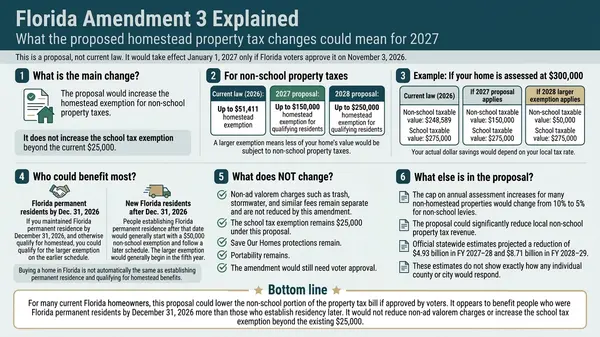
November 2026 update: Florida voters approved Amendment 3 according to unofficial election-night results. The amendment changes certain Homestead property-tax benefits beginning in 2027. Homeowners considering a move should account for the applicable rules in the year of their purchase rather than relying on their current property-tax bill.
Downsizing Has a Special Portability Calculation
This is especially important for this article.
When the new homestead has a lower just value than the previous homestead, Florida does not necessarily transfer the full dollar amount of the old Save Our Homes assessment difference.
The portability benefit is generally proportional.
Florida's property-tax rules state that when downsizing, the transferred assessment difference must represent the same proportion of the new home's just value that the previous assessment difference represented relative to the prior home's just value, subject to the $500,000 maximum.
Miami-Dade provides a helpful official example:
Previous home market value: $250,000
Previous assessed value: $150,000
Save Our Homes assessment difference: $100,000
New home market value: $175,000
Because the new home is worth 70% of the previous home's market value, the example transfers $70,000 of assessment difference.
The resulting new assessed value is $105,000, before applicable exemptions.
The practical takeaway is simple:
Do not assume downsizing means your entire accumulated tax benefit transfers dollar-for-dollar.
Use the Miami-Dade Property Appraiser's property-specific information and, where appropriate, request a portability estimate before relying on projected taxes.
A Smaller Condo Can Have Bigger Association Costs
For some Miami homeowners, downsizing means moving from a single-family house to a condominium.
That can reduce personal responsibility for exterior maintenance, landscaping, roofs, pools, and other common elements.
But those responsibilities do not disappear.
They may become part of the association's budget.
That is why the monthly condominium fee should never be evaluated by itself.
Ask what the fee covers, then examine the association's broader financial condition.
For Florida condominium resales, current law gives prospective buyers rights to receive documents including the association's annual financial statement and budget, and, where applicable, milestone inspection information and the association's most recent Structural Integrity Reserve Study, or SIRS.
A SIRS evaluates reserve needs for major structural components in qualifying condominium buildings. Florida's Department of Business and Professional Regulation explains that if required reserves are insufficient for anticipated structural work, associations may need additional funding mechanisms that can include assessments or borrowing.
Therefore, before deciding that a particular condo represents a lower-cost lifestyle, review more than:
“What is the HOA fee?”
Also investigate:
- the association budget,
- reserves,
- known special assessments,
- planned major projects,
- applicable inspection reports,
- what insurance is carried by the association,
- what coverage the unit owner would need separately,
- and whether the building's financial obligations fit your own budget.
A higher association fee is not automatically bad.
A lower fee is not automatically good.
The important question is what the fee funds and what future obligations may remain.
Special Assessments Can Change the Comparison
A special assessment is particularly important when someone is moving into a condominium to simplify life.
If the replacement property has a known assessment, determine:
- the total amount attributable to the unit,
- how much remains unpaid,
- the payment schedule,
- what project or obligation it funds,
- and how the purchase contract addresses responsibility for it.
Do not stop with the existing assessment.
Review the building's reserve and inspection information for other significant financial needs that may be known.
Florida law now contains detailed reserve requirements for many condominium associations subject to Structural Integrity Reserve Studies, including restrictions on waiving required reserves for specified structural components.
This does not mean a condo with an assessment is automatically a poor choice.
The assessment may fund important work that improves the building.
It simply belongs in the cost comparison before you decide the smaller home is financially easier.
Insurance Can Also Move in Either Direction
A smaller property does not guarantee a smaller insurance expense.
Insurance is property-specific.
For a single-family home, factors such as construction, roof, location, replacement cost, wind exposure, coverage, and deductibles can affect the premium.
For a condominium, the unit owner needs to understand what the association's policy covers and what separate coverage may still be appropriate for the unit.
Flood insurance is also a separate consideration. Florida's Department of Financial Services explains that standard homeowners policies generally do not cover flood damage and that separate flood coverage may be needed.
The most reliable approach is therefore:
Get property-specific insurance information for the replacement home before making the final financial comparison.
Do not assume insurance savings based on size alone.
Maintenance May Be Where Downsizing Provides the Greatest Relief
Not every benefit belongs in a spreadsheet.
A homeowner may move from a larger single-family property with:
- a pool,
- extensive landscaping,
- an aging roof,
- multiple air-conditioning systems,
- unused bedrooms,
- stairs,
- and constant small repairs
into a smaller property where some of those responsibilities are reduced or handled collectively.
Even if the new monthly housing cost is only slightly lower, reducing the amount of time, energy, and uncertainty required to maintain the home may have meaningful value.
Your guide to right-sizing when a Miami home begins to feel like too much explores this emotional and lifestyle side in greater depth.
That distinction is important:
Downsizing focuses on size. Right-sizing focuses on fit.
The best next home may be smaller.
It may also simply be easier.
The Third Question: Would Downsizing Improve Your Long-Term Financial Security?
Once you understand the cash generated by the sale and the ongoing cost of the replacement home, ask what the move changes over the longer term.
1. Would you retain stronger cash reserves?
A move that releases equity can provide more liquidity.
But only if that cash is not immediately consumed by the next purchase, renovations, debt, or transaction costs.
2. Would your recurring housing expenses become more predictable?
A newer home or well-managed condominium may reduce some maintenance uncertainty.
But association dues, assessments, insurance, and property taxes can also change.
Predictability needs to be evaluated property by property.
3. Would you reduce financial concentration in one home?
Some homeowners have a large portion of their net worth tied to their residence.
Downsizing can potentially release part of that equity.
How that money should be handled afterward is a financial-planning question rather than a real estate question.
4. Would the new home remain comfortable if circumstances change?
Think beyond today's needs.
Consider:
- accessibility,
- stairs,
- parking,
- proximity to family,
- healthcare,
- transportation,
- hurricane preparation,
- storage,
- pets,
- guests,
- and whether the property can work for the years you expect to live there.
Moving twice because the first “smaller” home did not actually fit the next stage of life can be expensive and exhausting.
Downsizing Is Not Only for Retirees
People right-size homes for many reasons.
A recently divorced homeowner may no longer need the same property.
A couple whose children have left home may prefer more flexibility.
Someone who travels frequently may want less maintenance.
A homeowner caring for an aging parent may need a different layout rather than less square footage.
Another family may want to sell a large property in one neighborhood and buy something smaller closer to work or relatives.
The decision is not defined by age.
It is defined by whether the current home still fits the homeowner's financial needs, physical needs, and desired lifestyle.
Five Questions to Answer Before Assuming Downsizing Will Save Money
1. What will I actually keep after selling?
Use realistic sale proceeds after mortgage payoff, selling expenses, preparation, and transition costs.
2. How much cash will I use for the replacement home?
Separate the amount you can use from the amount you want to use.
3. What will the replacement property cost to own each month?
Include taxes, insurance, association expenses, assessments, maintenance, and financing.
4. What Florida property-tax benefit might I actually receive?
Do not assume your current tax bill or full Save Our Homes benefit transfers unchanged.
5. What does the move improve besides the numbers?
Less maintenance, easier access, better location, proximity to family, travel flexibility, and peace of mind can all have legitimate value.
When Downsizing May Improve the Financial Picture
Downsizing may provide a meaningful financial benefit when the move:
- releases usable equity,
- materially reduces recurring housing costs,
- eliminates or reduces mortgage debt,
- reduces maintenance responsibilities,
- leaves adequate reserves,
- and places the homeowner in a property that can work for many years.
The more of those goals one move accomplishes, the stronger the financial case may become.
When a Smaller Home May Not Save Much
The financial advantage may be smaller when the homeowner:
- gives up unusually favorable existing financing,
- moves into a property with substantial association fees,
- faces significant special assessments,
- uses most available equity toward the replacement home,
- experiences a higher new property-tax burden than expected,
- takes on new financing,
- or incurs significant transaction and moving expenses.
That does not make the move wrong.
It means the homeowner should understand what the move is actually buying.
If the answer is greater freedom, accessibility, less maintenance, a better location, or a home that simply feels easier to live in, modest financial savings may still be acceptable.
A Better Definition of a Successful Downsize
A successful downsize is not necessarily:
“I moved into fewer square feet.”
It is closer to:
“My housing now fits my life better, and I understand what the change did to my finances.”
For one homeowner, success may mean eliminating a mortgage.
For another, it may mean releasing cash.
For another, monthly expenses may stay almost unchanged, but yard work and maintenance disappear.
And for someone else, the numbers may reveal that staying in the existing home still makes more sense.
That is useful information too.
Bottom Line
A smaller Miami home does not automatically mean a smaller housing budget.
To determine whether downsizing will genuinely improve your financial position, look at three separate questions:
How much cash will remain after the entire move?
What will the replacement property really cost each month?
Will the move improve your long-term financial flexibility and quality of life?
Do not compare square footage alone.
Do not compare purchase prices alone.
And do not assume your current mortgage, property taxes, insurance, or Save Our Homes benefit will carry over unchanged.
The best downsizing decision is the one that gives you a home that fits the life you want next while leaving you comfortable with the financial tradeoffs required to get there.
Sometimes that means moving.
Sometimes it means waiting.
And sometimes the numbers confirm that the home you already own still makes the most sense.
The purpose of doing the calculation is not to push yourself toward a sale.
It is to give yourself enough clarity to make the decision with confidence.
Frequently Asked Questions
Does buying a smaller home always reduce monthly housing costs?
No. A smaller home can have higher financing costs, property taxes, insurance, HOA or condominium fees, special assessments, or other recurring expenses. Compare total ownership costs rather than purchase prices alone.
Does my Homestead Exemption transfer when I downsize in Florida?
No. Florida's Homestead Exemption itself does not transfer from one property to another. You must qualify and apply for Homestead on the new property. Eligible homeowners may separately qualify for Save Our Homes portability.
Do I keep my entire Save Our Homes benefit when I buy a cheaper home?
Not necessarily. When the new homestead has a lower just value than the prior homestead, Florida generally uses a proportional portability calculation, subject to the applicable rules and $500,000 maximum.
Is a Miami condo automatically cheaper than a single-family home?
No. A condo may reduce individual maintenance responsibilities, but association fees, insurance, reserve funding, and special assessments can materially affect total ownership cost.
What should I review before buying a Florida condominium?
Review the association's financial statements and budget, known assessments, governing documents, and applicable milestone inspection and Structural Integrity Reserve Study information. Also investigate property-specific insurance and financing.
How much of my home equity should I use for the next purchase?
There is no universal answer. Consider the financing cost of the replacement home alongside the amount of cash you want to retain for emergencies, healthcare, retirement, travel, repairs, or other goals.
Can downsizing make sense even if it does not save much money?
Yes. Reduced maintenance, accessibility, location, travel flexibility, proximity to family, and a home that better fits your lifestyle can provide meaningful value even when direct financial savings are modest.
How do I know whether downsizing is financially worthwhile?
Estimate your net proceeds after selling, calculate the full cost of the replacement property, determine how much cash would remain after closing, and compare the long-term financial and lifestyle effects of both homes.
Recent Posts







GET MORE INFORMATION