
Should You Buy a Florida Home Before January 1, 2027, for Amendment 3 Eligibility?

Buying a Florida home before January 1, 2027 does not, by itself, guarantee eligibility for the larger Homestead Exemption proposed under Florida Amendment 3.
The proposal distinguishes between people who maintained permanent residence in Florida as of December 31, 2026 and people who establish Florida permanent residence afterward. Separately, current Florida Homestead law generally requires you to have legal or equitable title to the property and make it your permanent residence as of January 1 of the tax year for which you claim Homestead Exemption. Florida Senate
Those dates are related, but they do not mean the same thing.
A purchase contract, closing date, Florida driver's license, mailing address, or utility bill can be relevant evidence, but no single item automatically establishes permanent Florida residency. Under current Florida law, the county property appraiser makes that factual determination. Online Sunshine
That is why someone considering a Florida home purchase should not rush a major real estate decision based only on the proposed tax amendment.
Key Takeaways
|
Question |
Short Answer |
|
Does buying before January 1, 2027 guarantee the larger exemption? |
No. Ownership alone does not establish permanent residency. |
|
What is Amendment 3's key transition date? |
December 31, 2026, for determining whether a person had maintained Florida permanent residence. |
|
What date matters for ordinary Homestead eligibility? |
Generally January 1 of the applicable tax year. |
|
Must an existing Florida resident already own a home by December 31? |
The proposal says qualifying residents may have “established or will establish homestead,” so the residency cutoff is not simply a home-purchase cutoff. |
|
What happens to people becoming Florida residents after 2026? |
They would generally start with a smaller non-school exemption and potentially reach the larger exemption beginning with the fifth year of exemption. |
|
Does the proposal change school taxes the same way? |
No. The constitutional school Homestead Exemption remains up to $25,000. |
|
Does Save Our Homes remain? |
Yes. |
|
Does portability remain? |
Yes. |
|
Is Amendment 3 already law? |
No. Florida voters decide it November 3, 2026. |
Florida's Department of State currently lists Amendment 3 as active on the 2026 ballot. The general election is November 3, 2026. Constitutional Initiatives
For the complete explanation of the ballot measure itself, read Florida Amendment 3 Explained: What the Proposed Homestead Property Tax Changes Mean for 2027.
Is January 1, 2027 Really the Deadline to Buy?
Not exactly.
This is the most important distinction in the article.
Amendment 3 identifies people who maintained permanent residence in Florida as of December 31, 2026 and who have established or will establish Homestead Exemption.
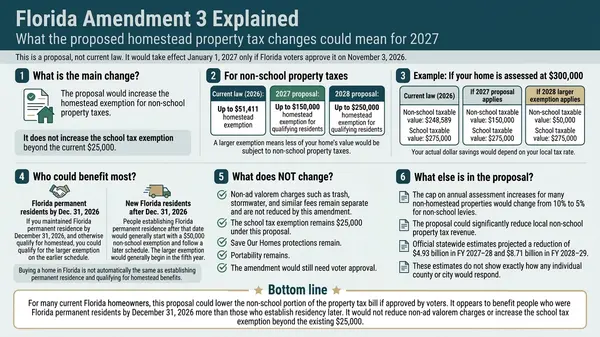
The official Florida Senate summary says that this group would receive, for non-school ad valorem levies:
- up to $150,000 of assessed value beginning January 1, 2027, and
- up to $250,000 beginning January 1, 2028, with positive inflation adjustments thereafter.
The same official summary separately addresses people who establish Florida permanent residence on or after January 1, 2027. Florida Senate
So December 31 is fundamentally a residency cutoff in the proposed amendment.
It is not simply a rule saying:
“Whoever buys a Florida house by December 31 gets the larger exemption.”
The actual constitutional text requires legal or equitable title and a qualifying permanent residence before a property receives Homestead Exemption. Initiative Petitions
Why Are December 31, 2026 and January 1, 2027 Different?
There are two separate questions.
December 31, 2026: Which Amendment 3 residency group are you in?
The proposal distinguishes people who maintained Florida permanent residence by December 31, 2026 from people who had not. Initiative Petitions
January 1: Do you qualify for Homestead Exemption on this particular property for that tax year?
Under current Florida Statute 196.031, a person claiming Homestead generally must, on January 1:
- have legal or beneficial title in equity to the Florida property, and
- in good faith make the property his or her permanent residence, or the permanent residence of a qualifying dependent. Online Sunshine
The Florida Department of Revenue's Homestead application likewise states that the person must own Florida real property on January 1 and make it the qualifying permanent residence. Florida Department of Revenue
So the two questions are:
Were you already a Florida permanent resident by the Amendment 3 cutoff?
and
Did you own and occupy the specific home as your qualifying permanent residence on January 1?
Those questions should not be collapsed into one closing-date rule.
What Does Amendment 3 Say About Existing Florida Residents?
The proposed amendment is written broadly enough to cover Florida permanent residents who already have a homestead or establish one later.
The Florida Senate's official summary describes the group as persons who maintained permanent residence as of December 31, 2026 and “have established or will establish homestead.” Florida Senate
That wording matters.
It means the proposal does not appear to require every existing Florida permanent resident to already own a homesteaded property on December 31, 2026 merely to belong to the pre-2027 residency group.
For example, a person who genuinely lives permanently in Miami-Dade as a renter on December 31, 2026 and later purchases a qualifying Florida homestead is different from someone whose permanent residence remains in New York until March 2027.
The first person already maintained Florida permanent residence by the proposed cutoff.
The second did not.
Exactly how the provision would be administered would still be subject to implementing law if the amendment passes.
What Happens If You Become a Florida Resident After 2026?
Under Amendment 3, a person who had not maintained permanent residence in Florida by December 31, 2026 would generally receive, upon qualifying for Homestead, up to:
- $25,000 for school district levies, and
- $50,000 for non-school levies.
The non-school amount would receive positive inflation adjustments beginning in 2028. Beginning with the fifth year of exemption, that person could become eligible for the larger exemption available to the earlier-resident group, subject to the amendment's terms and implementing law. Initiative Petitions
Notice the wording carefully.
The constitutional text refers to the fifth year of exemption.
That should not casually be rewritten as:
- five years after buying the house,
- five years after signing a purchase contract, or
- necessarily five years after first arriving in Florida.
Those events can occur on different dates.
The Florida Department of State also notes that this residency-based provision applies “to the extent permitted by the U.S. Constitution.” Constitutional Initiatives
That is another reason not to treat every future implementation detail as settled today.
Does Closing on a Florida Home Before December 31 Establish Permanent Residency?
Not automatically.
Owning Florida real estate and being a Florida permanent resident are different legal concepts.
Florida Statute 196.015 says the intention to establish permanent residence is a factual determination made initially by the property appraiser. No single factor is conclusive. Online Sunshine
Factors the property appraiser may consider include:
- declaration of domicile,
- where dependent children attend school,
- employment location,
- when previous non-Florida residency ended,
- Florida voter registration,
- Florida driver's license or identification,
- relinquishment of another state's driver's license,
- Florida vehicle registration,
- federal income-tax return address,
- bank-account address, and
- utility payments at the claimed homestead. Online Sunshine
Miami-Dade's own Homestead application materials similarly require proof of ownership and Florida residency and explain that the Property Appraiser determines eligibility. Miami-Dade County
Therefore:
A December closing may be relevant, but the closing itself does not prove permanent Florida residency.
Does Getting a Florida Driver's License Before December 31 Guarantee Eligibility?
No.
A Florida driver's license is one of several pieces of evidence a property appraiser may consider.
Florida law expressly says that no one factor is conclusive when determining permanent residence. Online Sunshine
The same applies to:
- voter registration,
- a declaration of domicile,
- changing your mailing address,
- opening a Florida bank account, or
- putting utilities in your name.
Those facts can support a residency claim.
They do not turn a residency determination into a checklist where obtaining one document automatically creates permanent residence.
Five Real-Life Buyer Scenarios
Scenario 1: A Current Miami-Dade Homeowner Staying in Florida
Maria has owned and homesteaded her Miami home for ten years.
She is unquestionably a Florida permanent resident before December 31, 2026.
If Amendment 3 passes, she falls within the proposed pre-2027 residency group.
If she stays in the same homestead, the proposed larger non-school exemption could apply under the amendment's schedule.
If she later sells and buys another Florida homestead, her pre-2027 permanent residency does not appear to disappear simply because she changes homes.
She may also have a separate Save Our Homes portability benefit available when moving.
For how that works, see Florida Homestead Portability Explained.
Main point: An existing Florida homeowner does not need to buy another home before 2027 merely to prove that he or she was already a Florida permanent resident.
Scenario 2: A Florida Renter Buying a First Home in 2027
David has rented an apartment in Miami since 2024 and has genuinely maintained Florida as his permanent residence.
He purchases his first home in June 2027.
Because he did not own that home on January 1, he generally would not qualify for Homestead Exemption on that property for the 2027 tax year under today's January 1 framework. Online Sunshine
But Amendment 3's transition language is based on whether he maintained Florida permanent residence by December 31, 2026, and expressly addresses people who “will establish homestead.” Florida Senate
Therefore, the proposal should not be summarized as requiring David to buy a home before 2027 simply to preserve the earlier-resident category.
His actual exemption year and application would still need to follow the applicable Homestead rules and any implementing legislation.
Main point: Existing Florida residency and current homeownership are not the same thing.
Scenario 3: An Out-of-State Buyer Relocating to Miami
Susan currently lives permanently in Illinois and plans to relocate to Miami.
She signs a purchase contract on December 15, 2026 but closes January 8, 2027 and moves to Florida afterward.
Signing the contract does not, by itself, establish that she maintained Florida permanent residence as of December 31.
Under the proposal, someone who had not maintained Florida permanent residence by that cutoff would generally enter the newer-resident exemption path. Constitutional Initiatives
She also would not meet the ordinary January 1 ownership requirement for a 2027 Homestead Exemption on a property she does not acquire until January 8.
Main point: A signed contract and permanent Florida residency are different legal facts.
Scenario 4: A Seasonal Florida Property Owner
Robert owns a condominium in Miami Beach but spends part of the year there.
His permanent residence remains in another state, where he keeps his primary legal, tax, and personal ties.
Owning the Miami Beach condominium before December 31 does not automatically make Robert a Florida permanent resident.
If he establishes Florida permanent residence only after the proposed cutoff, the new-resident provisions could apply if Amendment 3 passes.
Main point: Owning a Florida property is not the same as permanently residing in Florida.
Scenario 5: A Florida Homeowner Buying a Replacement Home
Ana currently owns and homesteads a home in Kendall.
In 2027 she sells it and purchases another home in Coral Gables.
She already maintained Florida permanent residency before the December 31, 2026 cutoff.
Her home purchase is therefore primarily a new-homestead and portability question, rather than a question about becoming a Florida resident for the first time.
If eligible, she may be able to transfer part of her accumulated Save Our Homes assessment difference to the replacement property. The proposed Amendment 3 text preserves the portability framework. Initiative Petitions
Main point: Existing Florida homeowners changing homes should evaluate portability as well as the proposed exemption.
What Could the Financial Difference Be If Amendment 3 Passes?
The largest difference between the two proposed residency groups concerns non-school ad valorem taxes.
For qualifying pre-2027 Florida residents:
2027: up to $150,000 exempt from applicable non-school assessed value.
2028: up to $250,000.
For people establishing Florida residency after the cutoff:
Initially: up to $50,000 for non-school levies, with the proposed inflation adjustment.
Beginning with the fifth year of exemption: potentially the larger exemption, subject to the proposal and implementing rules. Florida Senate
An illustrative example
Assume two homeowners each have enough assessed value to use the full relevant exemption in 2027.
One qualifies for a $150,000 non-school exemption.
The other qualifies for $50,000.
That is a $100,000 difference in non-school taxable value.
If the combined applicable non-school millage were hypothetically 10 mills:
$100,000 × 10 ÷ 1,000 = $1,000
That would represent a $1,000 difference in that illustrative calculation.
It is not a prediction of anyone's tax savings.
Actual results depend on the property's assessed value, municipality, taxing districts, millage rates, other exemptions, special assessments, and final implementation of Amendment 3.
For property-specific budgeting, see How to Estimate Miami-Dade Property Taxes Before Buying a Home.
Would the Larger Exemption Reduce School Taxes Too?
No.
Under the proposed amendment, the constitutional Homestead Exemption for school district levies remains up to $25,000. Initiative Petitions
The $150,000 and $250,000 amounts apply to non-school levies.
That means a buyer should never estimate potential Amendment 3 savings by applying the larger exemption to the entire tax bill.
Miami-Dade County Public Schools taxes would remain treated separately.
What Happens to Save Our Homes?
Amendment 3 does not eliminate Save Our Homes.
Save Our Homes limits annual increases in the assessed value of qualifying homestead property. Under current law, that limit is generally the lower of 3% or the applicable Consumer Price Index change. Online Sunshine
The proposed amendment preserves that framework. Initiative Petitions
Remember the distinction:
Homestead Exemption reduces taxable value.
Save Our Homes limits future assessed-value growth.
For the complete explanation, see Save Our Homes Explained for Miami-Dade Homeowners.
What Happens to Portability?
Portability also remains under Amendment 3.
Under current Florida law, qualifying homeowners may transfer up to $500,000 of eligible Save Our Homes assessment difference to another Florida homestead, subject to the portability rules. Online Sunshine
For a current Florida homeowner contemplating a move, portability may affect the new property's assessed value independently of Amendment 3's larger proposed exemption.
That is why a longtime Miami homeowner evaluating a move should consider:
assessment after purchase + portability + Homestead Exemption + millage rates + non-ad valorem assessments
rather than focusing on Amendment 3 alone.
Would CDD Fees or Other Non-Ad Valorem Assessments Change?
The proposed larger Homestead Exemption addresses ad valorem taxes, which are taxes based on property value.
CDD charges and other non-ad valorem assessments are separate.
Therefore, a larger Homestead Exemption does not automatically eliminate those charges.
For buyers comparing the true annual cost of properties, see CDD Fees and Non-Ad Valorem Assessments in Miami-Dade.
What If Amendment 3 Does Not Pass?
Then the proposed constitutional changes do not take effect.
Current Florida property-tax rules continue unless changed through some other lawful process.
As of October 20, 2026, Amendment 3 is still an active ballot proposal, not current law. Florida voters will decide it in the November 3, 2026 general election. Constitutional Initiatives
This distinction matters when making a purchase decision before Election Day.
A projected Amendment 3 tax benefit should not be treated as guaranteed.
Who Decides Whether You Are a Florida Permanent Resident for Homestead Purposes?
For Homestead Exemption, the county property appraiser makes the initial factual determination of permanent residency. Online Sunshine
For a Miami-Dade property, that means the Miami-Dade Property Appraiser.
The office reviews ownership, residency documentation, and the facts surrounding the application.
Miami-Dade's current guidance requires proof of January 1 ownership and proof of Florida residency, and its application materials identify documents that can support the claim. Miami-Dade County
A Realtor, closing agent, lender, driver's-license office, or utility company does not make the final Homestead eligibility determination.
What Should a Buyer Verify Before Making a Purchase Decision?
Before changing the timing of a home purchase because of Amendment 3, verify six things:
- Your actual Florida residency status. Determine whether you genuinely maintained Florida permanent residence by December 31, 2026 rather than assuming ownership creates residency.
- Your January 1 ownership and occupancy position. Current Homestead law uses January 1 as the key qualification date for the tax year.
- Whether Amendment 3 has actually passed. Until the election result is known, it remains a proposal.
- How the implementing rules apply to your circumstances. If approved, additional statutory and administrative guidance may be needed.
- Your actual property-tax estimate. Consider school taxes, non-school taxes, portability, millage rates, and non-ad valorem charges.
- The entire financial decision. Purchase price, mortgage rate, insurance, HOA or condo fees, closing costs, maintenance, and personal timing may outweigh any projected property-tax difference.
A home purchase is too large a financial decision to reduce to one proposed exemption.
Should You Move a Closing Earlier Just Because of Amendment 3?
There is no universal answer, because moving a closing date can affect much more than property taxes.
More importantly, an earlier closing does not guarantee that the buyer satisfies Amendment 3's proposed permanent-residency distinction.
For someone already permanently residing in Florida, buying before year-end may not be necessary simply to remain in the pre-2027 residency group because the amendment expressly refers to residents who have or will establish homestead. Florida Senate
For an out-of-state person genuinely relocating before year-end, closing before January 1 may be one relevant fact because current Homestead law requires ownership on January 1 for that year's exemption.
But ownership is still only part of the analysis.
Permanent residency must also be genuine and supportable.
The appropriate question is therefore not:
“Can I close before December 31?”
It is:
“What will my actual ownership, residency, and Homestead status be on the dates the law requires?”
Bottom Line
Buying a Florida home before January 1, 2027 does not automatically protect or create eligibility for the larger Homestead Exemption proposed under Amendment 3.
The amendment's transition rule focuses on whether a person maintained permanent residence in Florida by December 31, 2026.
Current Florida Homestead law separately focuses on whether the person owns the qualifying property and makes it a permanent residence as of January 1 of the applicable tax year.
Those rules produce very different outcomes for:
- existing Florida homeowners,
- Florida renters buying their first home,
- new residents moving from another state,
- seasonal Florida property owners, and
- homeowners moving from one Florida homestead to another.
If Amendment 3 passes, these distinctions could affect the amount of non-school assessed value exempt from taxation.
But Amendment 3 is still a proposal as of October 20, 2026.
No one should assume a specific tax savings, residency determination, or Homestead entitlement based only on a closing date.
For a property-specific situation, verify the facts with the county property appraiser and, when necessary, a qualified tax or legal professional before changing a major real-estate decision.
This article is for general educational purposes and does not recommend how anyone should vote or whether anyone should purchase, sell, or accelerate the purchase of real estate.
Frequently Asked Questions
Do I have to buy a Florida home before January 1, 2027 to receive the larger Amendment 3 exemption?
Not necessarily. Amendment 3's transition language focuses on whether a person maintained permanent residence in Florida by December 31, 2026 and has established or will establish homestead. Homeownership by the cutoff is not stated as the sole test.
Does closing on a Florida home before December 31, 2026 make me a Florida permanent resident?
No. Closing establishes ownership, not automatically permanent residency. Under Florida law, permanent residency is a factual determination, and the county property appraiser may consider multiple forms of evidence.
What is the difference between December 31, 2026 and January 1, 2027?
December 31, 2026 is the proposed Amendment 3 cutoff distinguishing existing and later Florida permanent residents. January 1 is generally the current-law date on which ownership and permanent-residence requirements are measured for Homestead Exemption for that tax year.
If I already live in Florida but rent, do I need to buy before 2027?
The amendment's official legislative summary includes people who maintained Florida permanent residence by December 31, 2026 and “have established or will establish homestead.” Therefore, existing Florida permanent residency is distinct from already owning a homestead. Actual administration would depend on the final law if Amendment 3 passes.
What happens if I move to Florida after January 1, 2027?
Under the proposal, a later resident who qualifies for Homestead would generally begin with up to $50,000 of non-school exemption, adjusted as provided by the amendment. Beginning with the fifth year of exemption, that person may become eligible for the larger exemption, subject to the amendment's rules.
Does a Florida driver's license prove permanent residency for Amendment 3?
A Florida driver's license is relevant evidence, but Florida law says no single factor is conclusive when determining permanent residence for Homestead purposes.
What if I already own a Florida vacation home?
Ownership alone does not establish that Florida is your permanent residence. A seasonal owner whose permanent residence remains elsewhere may be treated differently if that person later establishes Florida permanent residence.
If I already have a Florida homestead and move in 2027, do I lose the larger Amendment 3 exemption?
The proposed transition is based on the person's Florida permanent-residency status, not simply remaining in the same property. An existing Florida homeowner may also qualify separately for Save Our Homes portability when establishing a replacement homestead.
Would Amendment 3 reduce school property taxes by the full proposed $150,000 or $250,000 exemption?
No. The proposed larger exemption applies to non-school levies. The constitutional Homestead Exemption for school district levies remains up to $25,000.
What happens if Amendment 3 fails?
The proposed constitutional changes do not take effect. Current Florida property-tax and Homestead rules would continue unless separately changed.
Recent Posts




GET MORE INFORMATION