
Staying in Your Miami Home? How to Plan for the Next Five Years of Costs

Staying in your Miami home can be a financially sensible choice, but your current mortgage payment does not tell you what the next five years of homeownership may cost.
A useful plan starts with actual bills, identifies major systems and known obligations, and separates future expenses into three categories: known, reasonably estimated, and still unknown.
The goal is not to predict the future.
It is to reduce avoidable surprises while helping you feel more confident about the home you have chosen to keep.
Key Takeaways
- Start with what your home actually costs today, using bills and statements rather than estimates.
- Check whether property taxes and insurance are already included in your mortgage payment before adding them separately.
- Do not assume a roof, air-conditioning system, water heater, or other component must be replaced simply because it reaches a certain age.
- Use condition, service history, permit records, inspections, and professional estimates to clarify major future expenses.
- Treat an approved assessment or contracted obligation differently from a possible expense that may never happen.
- Do not assume property taxes, insurance premiums, utilities, or repair costs will increase by a fixed percentage every year.
- Review your Miami-Dade TRIM Notice annually rather than trying to forecast future property taxes.
- The most useful five-year plan does not eliminate uncertainty. It tells you which uncertainty deserves attention next.
Before You Start: Gather These Records
You do not need sophisticated software to create this plan.
Start with the documents you already have:
- recent mortgage statement,
- latest property-tax bill,
- latest Miami-Dade TRIM Notice,
- homeowners insurance declarations page and renewal notice,
- flood insurance policy, if applicable,
- HOA or condominium budget and assessment notices, if applicable,
- the last 12 months of utility bills,
- lawn, pool, pest-control, generator, or other service costs,
- roof, air-conditioning, plumbing, electrical, and appliance records,
- warranties and service invoices,
- permit records for major improvements,
- and any recent inspection reports or written repair estimates.
Do not worry if some of these are missing.
Finding the missing information is part of the exercise.
Step 1: Start With What Your Home Actually Costs Now
The first mistake homeowners often make is beginning with future repairs.
Start with the present.
What does it cost you to live in the house during a normal year?
Begin With Your Mortgage Statement
Separate the components of the payment if possible.
Your monthly payment may include:
- principal,
- interest,
- property-tax escrow,
- homeowners insurance escrow,
- mortgage insurance, if applicable,
- and other amounts handled by your mortgage servicer.
The Consumer Financial Protection Bureau explains that many borrowers' total mortgage payments already include money collected through escrow for property taxes and homeowners insurance.
That creates an easy budgeting mistake.
If your monthly mortgage payment already includes taxes and insurance, do not add those amounts again when calculating the cost of staying in the home.
You have two good options:
Option 1: Record the total mortgage payment and mark taxes and insurance as “included in mortgage payment.”
Option 2: Break the payment into principal and interest, taxes, insurance, and other escrow items.
Either method works.
Just do not count the same expense twice.
A Small Accounting Distinction
For household cash-flow planning, your full principal-and-interest payment matters because the money leaves your bank account every month.
Financially, principal is different from interest because principal reduces the amount you owe.
You do not need to turn this exercise into an accounting project, but that distinction can be helpful when comparing your home's cash requirements with your long-term financial position.
Use a Full Year for Seasonal Expenses
One electric bill does not tell you what electricity costs in Miami.
Neither does one water bill.
Whenever possible, review the previous 12 months for:
- electricity,
- water and sewer,
- gas, if applicable,
- lawn service,
- pool service,
- pest control,
- generator maintenance,
- security monitoring,
- and other recurring household services.
Then calculate an annual total or monthly average.
This avoids making a five-year decision based on an unusually mild month or an unusually expensive summer.
Include Association Costs if They Apply
If you live in an HOA, condominium, or another community with recurring dues, include:
- regular dues,
- approved increases,
- known special assessments,
- and other mandatory charges.
An approved assessment belongs in the plan.
A discussion or proposal that may lead to an assessment later should be tracked separately until the amount and obligation are clearer.
Step 2: Look Beyond the Monthly Bills
Once you know the recurring cost of the home, look at the physical property.
A house can have a manageable monthly payment and still require significant work during the next five years.
But this is where homeowners should avoid another common mistake:
Do not turn the age of every component into an automatic replacement date.
Create a Home Systems Inventory
For a Miami single-family home, your review might include:
|
Component |
What to Find Out |
|
Roof |
Installation date, permit history, current condition, leaks, repairs, inspection information |
|
Air-conditioning |
Approximate age, service history, recent repairs, current performance |
|
Water heater |
Age, condition, leaks, service history |
|
Plumbing |
Pipe material where known, leaks, recurring problems, recent repairs |
|
Electrical |
Panel information, known issues, prior upgrades |
|
Windows and doors |
Condition, storm protection, seals and hardware |
|
Pool and equipment |
Pump, filter, heater, surface condition, leaks |
|
Appliances |
Condition, service history, warranties |
|
Exterior |
Paint, stucco, drainage, fencing, driveway |
|
Landscaping |
Trees, irrigation, recurring maintenance |
|
Generator |
Service history, fuel system, battery and maintenance |
|
Septic or well |
Service history, if applicable |
Your home may have fewer or more items.
The purpose is not to generate a frightening replacement list.
It is to understand what you own.
Age Is Information, Not a Diagnosis
A 12-year-old system may have years of useful service remaining.
A much newer component can develop an unexpected problem.
That is why useful planning combines:
age + condition + maintenance history + professional evaluation when needed.
Florida's homeowners-insurance law provides a useful example of this principle for roofs.
For qualifying homeowners policies, an insurer generally cannot refuse issuance or renewal solely because a roof is less than 15 years old. If a roof is at least 15 years old, the homeowner must be allowed to obtain a roof inspection, at the homeowner's expense, from an inspector approved by the insurer who meets the statute's qualifications before replacement is required solely because of age. If that inspection shows at least five years of useful life remaining, the statute provides additional protection against refusal based only on roof age.
These protections concern roof age alone. They do not guarantee that an insurer must issue or renew a policy for every property or every other underwriting reason.
Ask your insurance agent which inspector and documentation your insurer accepts before arranging the inspection.
That does not mean every roof will last a particular number of years.
It means age alone should not be treated as a complete condition assessment.
The same planning philosophy is sensible for the rest of the home.
Use Permit History to Fill in Missing Dates
Longtime homeowners do not always remember exactly when a roof, addition, electrical panel, or air-conditioning installation was completed.
Miami-Dade allows property owners to search building-permit and inspection history online, including permit records associated with an address.
Permit records can help identify when work was permitted or inspected when your own receipts are missing.
However, a permit issuance date by itself does not necessarily establish the exact date work was completed or equipment was installed.
For work performed inside a municipality, additional municipal records may also be relevant.
Step 3: Separate Known Costs From Estimates and Unknowns
This is the most important step.
Do not put every potential future expense into one bucket.
Instead, use three labels.
Category 1: Known
A known cost is supported by something concrete.
Examples include:
- current mortgage payment,
- current insurance premium,
- current property-tax bill,
- current HOA dues,
- an approved special assessment,
- a signed maintenance agreement,
- or the documented price and payment schedule for approved or contracted work, subject to the agreement's scope and terms.
A current bill is known for its stated period, not for all five years.
A preliminary quote, undecided project, or notice about a proposal remains an estimate or an item to investigate until the amount and commitment are confirmed.
Category 2: Reasonably Estimated
An estimated cost has credible information behind it, but the amount or timing is not final.
Examples might include:
- a contractor's preliminary estimate,
- an HVAC technician telling you a repair will probably be needed within a certain period,
- a roof inspection identifying work that should be monitored,
- an association project under formal consideration but not yet approved,
- or a planned improvement for which you have begun collecting quotes.
Label these clearly as estimates.
Do not quietly convert them into facts.
Category 3: Unknown
Some expenses simply cannot be predicted responsibly.
Examples include:
- what your homeowners insurance premium will be four years from now,
- the exact future millage rate,
- when an appliance will fail,
- whether a storm will damage the property,
- what labor or material prices will be in 2030,
- or whether a currently healthy air-conditioning system will need replacement during your five-year window.
Those costs are not zero.
They are unknown.
That is an important difference.
Why This Classification Matters
Suppose your roof is older but currently functioning well.
You could write:
Roof replacement in Year 3: $30,000
But unless an inspection or other reliable information supports both that timing and amount, you have created a forecast that may be wrong twice.
A better entry might be:
Roof: condition to verify. Obtain inspection. Replacement timing and cost currently unknown.
That tells you what to do next without pretending you know what will happen.
Step 4: Build Your Five-Year Home Cost Planning Table
You do not need to predict the next five years. You only need to organize what you know today and identify what deserves a closer look.
Here is the table I would actually use.
Choose one method before filling in the table: either list your full mortgage payment and mark any taxes or insurance already included as “included in mortgage payment,” or enter principal and interest separately and record taxes and insurance on their own lines.
Record each expense only once.
Use the final property-tax bill for the amount currently billed. The TRIM Notice shows proposed taxes and is an annual review document.
Choose one method before filling in the table: either list your full mortgage payment and mark any taxes or insurance already included as “included in mortgage payment,” or enter principal and interest separately and record taxes and insurance on their own lines. Record each expense only once.
What You Know Today
Use this first table to record the information you have now.
| Cost / Component | Source of Information | Current Cost / Condition |
|---|---|---|
| Mortgage payment | Mortgage statement | $_____ / month; includes: _____ |
| Property taxes | Final tax bill / TRIM | $_____ / year or included in mortgage payment |
| Homeowners insurance | Declarations page | $_____ / year or included in mortgage payment |
| Flood insurance | Current policy | $_____ / year or included in mortgage payment |
| HOA / condo dues | Current budget | $_____ |
| Special assessments | Association documents | Confirmed: $_____ / Estimated: $_____ |
| Electricity | Last 12 months | $_____ / year |
| Water / sewer | Last 12 months | $_____ / year |
| Lawn / pool / pest | Actual bills | $_____ / year |
| Roof | Permit / inspection | Condition: _____ |
| Air-conditioning | Service records | Condition: _____ |
| Water heater | Records / inspection | Condition: _____ |
| Plumbing | Records / inspection | Condition: _____ |
| Electrical | Records / inspection | Condition: _____ |
| Pool / equipment | Service records | Condition: _____ |
| Appliances | Receipts / condition | Condition: _____ |
| Optional improvements | Your plans / quotes | Project: _____ |
| Emergency repair reserve | Household finances | $_____ available |
What to Plan for Next
Use this second table to decide what deserves attention during the next five years.
| Cost / Component | 5-Year Outlook | Action |
|---|---|---|
| Mortgage payment | Review loan terms, any scheduled rate changes, and escrow changes. Known now; future changes depend on loan and escrow terms. |
Review annually |
| Property taxes | Review each year. Known now; future variable. |
Check annual TRIM and final bill |
| Homeowners insurance | Future premiums unknown. Known now. |
Review at renewal |
| Flood insurance | Future premiums unknown. Known now. |
Review policy annually |
| HOA / condo dues | Approved changes: _____. Known / estimated. |
Review association budget |
| Special assessments | Payment schedule or decision date: _____. Known / estimated / unknown. |
Confirm status and terms |
| Electricity | No fixed forecast. Known baseline. |
Update annually |
| Water / sewer | No fixed forecast. Known baseline. |
Update annually |
| Lawn / pool / pest | Contracts may change. Known baseline. |
Review service needs |
| Roof | Timing: _____. Known / estimated / unknown. |
Inspect if unclear |
| Air-conditioning | Timing: _____. Known / estimated / unknown. |
Schedule service if needed |
| Water heater | Timing: _____. Known / estimated / unknown. |
Monitor |
| Plumbing | Work identified: _____. Known / estimated / unknown. |
Investigate concerns |
| Electrical | Work identified: _____. Known / estimated / unknown. |
Investigate concerns |
| Pool / equipment | Work identified: _____. Known / estimated / unknown. |
Review equipment |
| Appliances | Replacement unknown. Unknown unless an issue exists. |
Monitor |
| Optional improvements | Timing: _____. Optional. |
Keep separate from maintenance |
| Emergency repair reserve | Review periodically. Personal planning amount. |
Review whether the reserve still fits your needs |
Money already set aside for repairs is a reserve, not another repair bill.
Track that balance separately so the same repair is not counted once as savings and again as spending.
Prepare for Uncertainty Without Assigning It a False Price
You can prepare for repairs even when you cannot predict exactly when they will happen.
Review what you already have set aside, what your monthly budget can realistically support, and the estimates available for work you are considering.
Keep planned-project savings separate from money reserved for unexpected repairs and insurance deductibles.
A reserve is a cushion, not a prediction that you will spend it all.
Use Planning Ranges, Not False Precision
It may be tempting to add everything together and say:
“Our house will cost exactly $187,420 over the next five years.”
That precision would be misleading.
The planning table is more useful if it shows:
- your current annual baseline,
- known commitments,
- credible estimates,
- unresolved risks,
- and what information could reduce those risks.
You can total the costs you know.
You can create planning ranges for expenses supported by estimates.
Leave truly uncertain costs uncertain.
How Should You Plan for Miami Property Taxes?
For a homeowner staying in the same Florida homestead, property-tax planning requires an important distinction.
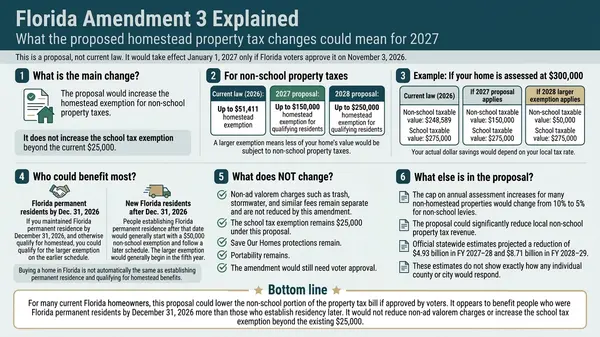
Florida's Save Our Homes limitation generally limits annual increases in the assessed value of qualifying homestead property to the lower of 3% or the applicable Consumer Price Index change.
The Florida Department of Revenue reported a 2.7% Save Our Homes cap for the 2026 assessment year.
But the Save Our Homes limitation is not a guarantee that your total tax bill can increase by only that percentage.
Your tax bill can also be affected by:
- applicable millage rates,
- taxable-value changes,
- exemptions,
- and non-ad valorem assessments.
Miami-Dade's TRIM Notice separately identifies proposed ad valorem property taxes and non-ad valorem charges such as certain service assessments.
For a deeper explanation of how the assessment limitation works, see my guide to Save Our Homes for Miami-Dade homeowners.
Use Your TRIM Notice as an Annual Checkpoint
Every August, the Miami-Dade Property Appraiser sends property owners a TRIM Notice showing:
- property values,
- exemption benefits,
- proposed taxes,
- non-ad valorem assessments,
- and budget-hearing information.
That makes August an excellent time to update your five-year planning table.
Your November tax bill then provides the final annual amount.
Instead of guessing that taxes will increase by 2%, 3%, or 5% every year, update the plan with actual information as it becomes available.
If you want help understanding the notice itself, see How to Read Your Miami-Dade TRIM Notice Without Panicking.
How Should You Plan for Homeowners Insurance?
Use the same approach.
Start with what is known.
Review:
- current annual premium,
- coverage limits,
- separate hurricane deductible,
- other deductibles,
- policy exclusions,
- roof information,
- and renewal date.
Do not assume today's premium will remain unchanged for five years.
But also do not invent a future annual increase.
Your planning entry might simply say:
2026 premium: known. 2027 renewal: unknown until quoted. Review before renewal.
That is more defensible than assuming a fixed escalation rate.
Remember That Flood Coverage Is Separate
Florida's Department of Financial Services explains that standard homeowners insurance does not cover flood damage.
Miami-Dade also maintains property-specific flood-zone information that homeowners can review by address.
If flood coverage applies to your planning, list it separately rather than assuming it is contained within the homeowners premium.
If You Live in a Condo or HOA Community
Your personal home-maintenance list may be shorter, but your planning responsibilities do not disappear.
Instead, some costs move to the association.
Review:
- current association dues,
- adopted annual budget,
- approved assessments,
- notices of proposed projects,
- reserve information where applicable,
- and recent meeting materials.
Again, separate:
approved cost from possible future cost.
If the board has officially approved an assessment, include the confirmed obligation.
If an official proposal includes a credible cost estimate, label it as estimated.
If owners are discussing a possible project but the amount or timing is still unclear, mark it as unknown and identify which association document or decision will clarify it.
Maintenance and Improvements Should Not Be Mixed Together
Another useful distinction is:
What does the home need?
versus
What would I like to change?
A leaking pipe is maintenance.
Replacing functioning kitchen cabinets because you want a different style is an improvement.
A failing air-conditioning component may be necessary work.
Adding a new outdoor kitchen is optional.
Both can require money.
But they should occupy different lines in your plan.
Why?
Because optional projects can be delayed, redesigned, reduced, or eliminated if your priorities change.
Necessary repairs usually provide less flexibility.
Keeping those categories separate gives you a more realistic picture of what staying actually requires.
What If Your Plan Reveals Several Expensive Questions?
Do not immediately conclude that you should sell.
The purpose of this exercise is not to turn normal homeownership into a list of reasons to leave.
Instead, rank the unanswered questions.
For example:
Largest unknown: roof condition.
Next step: locate permit information and obtain an appropriate roof inspection if needed.
Largest unknown: homeowners insurance.
Next step: review the declarations page and discuss the next renewal with the insurance agent.
Largest unknown: air-conditioning system.
Next step: schedule routine service and ask the technician about current condition.
Largest unknown: association assessment.
Next step: review the official budget, assessment documents, notices, and meeting records.
Largest unknown: property taxes.
Next step: review the current TRIM Notice and final tax bill.
One unanswered question at a time is much more manageable than imagining every possible expense simultaneously.
A Simple Annual Review Can Keep the Plan Useful
You do not need to rebuild the entire five-year plan every month.
Once a year, update:
- current mortgage information,
- property taxes,
- insurance,
- association costs,
- utilities,
- major-system condition,
- completed repairs,
- and new known projects.
Remove expenses that have already occurred.
Replace old estimates with actual amounts.
Move uncertain items into the known category when you receive reliable information.
The plan should become more accurate as time passes, not more complicated.
What If the Numbers Eventually Make You Reconsider Staying?
That is also a valid outcome.
A five-year home-cost review might confirm:
“This house is affordable, manageable, and still works well for us.”
It could also reveal:
“We can stay, but we need to prepare for several upcoming projects.”
Or perhaps:
“The financial and maintenance responsibilities of this home no longer fit the life we want.”
None of those conclusions is a failure.
If staying begins to feel less aligned with your priorities, my guide to whether downsizing in Miami would actually save money can help you compare the next step without assuming that smaller automatically means cheaper.
And if your thinking eventually shifts toward selling, the hidden costs Florida homeowners should calculate before selling are also worth reviewing before making plans around an expected sale price.
Publishing note: Verify the exact Lofty URL for the hidden-costs article before hyperlinking that phrase.
Your Next Step: Answer One Question
You do not need to predict five years of Miami housing costs this weekend.
Instead, ask:
“What is the largest home-related expense I do not understand well enough today?”
Then identify what would clarify it.
A bill?
A permit record?
An insurance conversation?
A service appointment?
An inspection?
An association document?
A written estimate?
That single answer gives you a useful next step without creating unnecessary anxiety.
Bottom Line
Choosing to stay in your Miami home can be just as intentional as choosing to move.
A good five-year plan does not try to guess future insurance premiums, property-tax rates, repair prices, or the exact year when a home system will fail.
It does something more practical.
It tells you:
what the home costs now,
what expenses you already know are coming,
what you can reasonably estimate,
what remains uncertain,
and which unanswered question deserves attention next.
That information can help you prepare financially while continuing to enjoy the home you have.
And if the numbers eventually point you toward a different choice, you will be making that decision with better information rather than fear.
Frequently Asked Questions
How much should I budget for home maintenance in Miami?
There is no single percentage that accurately fits every Miami home. A property's age, condition, size, systems, pool, roof, landscaping, association responsibilities, and maintenance history all affect future costs. A property-specific inventory is more useful than relying exclusively on a universal rule of thumb.
Should I assume my property taxes will increase every year?
Do not assume a fixed annual increase. Florida's Save Our Homes limitation can restrict assessed-value growth for qualifying homesteads, but the total tax bill can also be affected by tax rates, exemptions, and non-ad valorem assessments. Review your Miami-Dade TRIM Notice and final tax bill each year.
Is homeowners insurance already included in my mortgage payment?
It may be. Many mortgages collect property taxes and homeowners insurance through an escrow account as part of the total monthly payment. Check your mortgage statement before adding taxes and insurance separately to your housing budget.
Should I replace my roof just because it is 15 years old?
Not automatically. Roof condition, inspection results, insurance requirements, construction, repairs, and remaining useful life all matter. Florida law also provides certain inspection protections for qualifying homeowners policies involving roofs at least 15 years old. Ask your insurance agent which inspector and documentation your insurer accepts before arranging an inspection for insurance purposes.
How can I find out when work was done on my Miami-Dade home?
Miami-Dade provides online building-permit and inspection-history searches. Permit records can help identify dates associated with permitted roofing, mechanical, electrical, additions, and other work when your own records are incomplete, although a permit issuance date alone does not necessarily establish when work was completed.
Should I include a possible future special assessment in my plan?
Yes, identify it, but separate an approved obligation from a proposal. Record the confirmed amount and payment schedule for an approved assessment. If an official proposal includes a credible cost estimate, label it as estimated. If the amount or timing is still unclear, mark it as unknown and identify which association document or decision will clarify it.
Should optional renovations be included with maintenance?
Keep them separate. Necessary maintenance and repairs support the existing home, while optional improvements can often be postponed or changed. Separating them gives you a clearer picture of what staying truly requires.
Does planning for major repairs mean I should consider selling?
No. Homeownership naturally involves maintenance and occasional major expenses. The purpose of the plan is to help you prepare for them. Selling becomes a separate decision only if the home's financial, physical, or lifestyle demands no longer fit your goals.
Recent Posts







GET MORE INFORMATION