
Miami-Dade Property Tax Bill: 5 Things to Check Before You Pay

You open your Miami-Dade property tax bill and immediately have three questions.
Is this amount correct?
Didn't my mortgage company already take money for taxes?
And do I really save 4% if I pay before the end of November?
Those are reasonable questions.
Miami-Dade mailed its 2026 annual property tax notices on October 30, 2026, and homeowners with standard annual tax bills can receive the maximum November early-payment discount when eligible taxes are paid by November 30, 2026.
But before submitting a payment, take a few minutes to review the bill.
The goal is not simply to pay quickly.
It is to understand what you are paying, whether the information appears consistent with your property records, and whether someone else may already be scheduled to pay the bill through escrow.
Key Takeaways
- The August TRIM Notice showed proposed property taxes. Your current notice is the actual annual tax bill.
- Verify that your taxable values and property-tax exemptions are consistent with your Property Appraiser records.
- Non-ad valorem assessments are separate charges that are not based on your home's taxable value.
- If your mortgage payment includes a tax escrow account, confirm whether your mortgage servicer will pay the bill before sending a separate payment yourself.
- For standard 2026 annual payments, the maximum 4% early-payment discount is available through November 30, 2026.
- A $5,000 amount eligible for the 4% discount would produce $200 in savings.
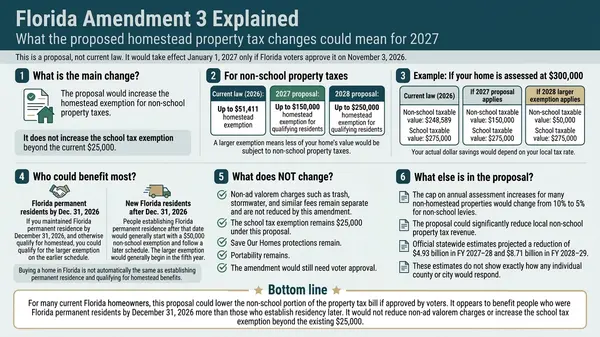
- Florida Amendment 3 does not change your 2026 tax bill. Its increased Homestead provisions begin with the 2027 tax year.
First, Know Who Does What
Florida property taxes involve several different government offices, which can make questions about a tax bill confusing.
The Miami-Dade Property Appraiser determines property values and administers exemptions and assessment benefits.
The various taxing authorities set the millage rates used to calculate ad valorem taxes.
The Miami-Dade County Tax Collector sends and collects the final tax bill.
The Tax Collector does not determine your home's value or decide whether you qualify for Homestead Exemption.
That distinction tells you where to direct a question.
If the concern is your property value or exemption, start with the Property Appraiser.
If the concern is payment, discount timing, or whether taxes have been paid, the Tax Collector is the appropriate office.
1. Does the Final Tax Bill Match What You Expected?
Start by comparing the November bill with the TRIM Notice you received in August.
TRIM stands for Truth in Millage.
The Miami-Dade Property Appraiser mails TRIM Notices each August showing:
- property values,
- exemption benefits,
- proposed ad valorem taxes,
- proposed non-ad valorem assessments,
- and taxing-authority budget hearing information.
Most importantly, the TRIM Notice states:
“This is not a bill.”
It is a notice of proposed property taxes.
Your November tax notice is different.
It reflects the annual tax amount after the tax roll and applicable rates move through the year's process.
Should the November bill equal the TRIM Notice exactly?
Not necessarily.
The TRIM Notice is designed to show what the taxes are likely to be, but it is still based on proposed taxes.
There can also be differences involving final non-ad valorem assessments or changes made after the TRIM Notice.
So a difference does not automatically mean the final bill is wrong.
It means you should identify where the difference came from.
Compare:
Taxable value
Exemptions
Ad valorem taxes
Non-ad valorem assessments
If you want a detailed explanation of the August document, see my guide How to Read Your Miami-Dade TRIM Notice Without Panicking.
2. Are Your Homestead and Other Exemptions Reflected Correctly?
Next, verify the property-tax benefits you expected to receive.
Your Property Appraiser records can show exemptions, classifications and assessment reductions associated with the property.
For a qualifying homeowner, those might include Homestead Exemption and other applicable benefits.
The Miami-Dade Property Appraiser specifically directs homeowners with questions about values or exemptions to contact that office.
What if something looks wrong?
Do not simply change the amount on the bill or assume the Tax Collector can correct an exemption.
Contact the Miami-Dade Property Appraiser and ask them to review the property record.
The office's current public-service number is 305-375-4712.
Because statutory application and appeal deadlines can apply, do not assume that discovering an issue in November automatically means a 2026 exemption can still be added or changed.
Ask the Property Appraiser what options apply to your specific situation.
Important 2026 clarification: Amendment 3 does not change this bill
Florida voters approved Amendment 3 on November 3, 2026.
However, Miami-Dade's Property Appraiser confirms that the increased Homestead Exemption begins with the 2027 tax year, including the approved increase to a maximum $150,000 exemption for qualifying homeowners in 2027.
It does not retroactively change the 2026 tax bill you are receiving now.
For today's bill, review the exemptions applicable to 2026.
For a deeper explanation of the existing system, see Miami-Dade Homestead Exemption Explained.
3. What Are Those Non-Ad Valorem Assessments?
One of the most common reasons a homeowner looks at a tax bill and thinks, “What is this charge?” is the non-ad valorem assessment section.
Ad valorem taxes are based on property value.
Non-ad valorem assessments are different.
Miami-Dade describes them as charges associated with specific services or benefits rather than the taxable value of the property. Examples can include:
- solid waste,
- street lighting,
- security services,
- landscaping or lake maintenance,
- water or sewer improvements,
- and other special-district assessments.
Why doesn't Homestead reduce these charges?
Because these assessments are not calculated using your home's taxable value.
Homestead Exemption and Save Our Homes affect the ad valorem side of the property-tax calculation.
They do not automatically reduce a property-specific non-ad valorem assessment.
That is why a homeowner with a favorable Homestead tax position can still have separate charges appearing on the same annual tax bill.
Were these supposed to be on the TRIM Notice?
Many appear on the TRIM Notice, but the Property Appraiser's own TRIM guidance warns that the final tax bill can contain non-ad valorem assessments that were not reflected on the earlier notice.
So if this section is different from what you remember seeing in August, identify the particular assessment rather than assuming the total bill was calculated incorrectly.
For a much deeper explanation, see CDD Fees and Non-Ad Valorem Assessments in Miami-Dade.
4. Does Your Mortgage Company Already Pay Your Property Taxes?
This is the question I would check before clicking the payment button.
If your mortgage payment includes an escrow account, your mortgage servicer may already be responsible for paying the annual property-tax bill from the money collected with your monthly payments.
Miami-Dade's Tax Collector answers this question very simply:
If you are unsure whether your mortgage or escrow company will pay your taxes, contact the company directly to confirm.
Receiving a tax notice does not mean you should assume you need to pay twice
If you escrow taxes, review:
- your mortgage statement,
- your escrow information,
- communications from your servicer,
- and the tax account's payment status.
Then contact the servicer if anything is unclear.
Do not make a second payment merely because the tax notice arrived.
What if you recently paid off or refinanced the mortgage?
This deserves extra attention.
The Tax Collector says homeowners do not need to separately notify its office when paying off a mortgage or changing mortgage companies because mortgage companies update the accounts they intend to pay.
But from the homeowner's perspective, a recent payoff, refinance, or servicing change is a good reason to confirm who is actually responsible for this year's payment.
A two-minute confirmation can be much easier than sorting out a duplicate or missed payment later.
5. What Should You Check Before November 30?
For homeowners paying the standard annual bill themselves, this is the time-sensitive part.
Miami-Dade's 2026 early-payment schedule is:
|
Payment period |
Early-payment discount |
|
By November 30, 2026 |
4% |
|
By December 31, 2026 |
3% |
|
By January 31, 2027 |
2% |
|
By February 28, 2027 |
1% |
|
March 2027 |
No discount |
Real estate taxes become delinquent on April 1, 2027.
What does a 4% discount look like?
Using the Tax Collector's own illustrative example:
Eligible taxes: $5,000
4% November discount: $200
Illustrative amount after that discount: $4,800
That does not mean every $5,000 tax notice will necessarily be discounted in exactly the same way across every component.
Use the official November amount shown for your account when determining what is actually due.
Check the payment method too
Miami-Dade currently allows payment online, by mail and in person.
For online payment:
- eCheck currently has no convenience fee
- consumer credit cards, debit cards and mobile wallets currently carry a 2.50% non-refundable convenience fee
- commercial or international cards can carry a higher fee.
That distinction matters when someone is paying early specifically to save money.
On a $5,000 payment, a 2.50% card fee would itself equal $125.
That does not mean one payment method is right for everyone.
It means you should look at the net cost of the payment method, not only the headline tax discount.
Pay attention to timing
For eligible payments:
- online and in-person discounts are generally based on the payment submission date,
- mailed payments use the postmark date,
- and the Tax Collector says bank bill-pay payments should be scheduled at least five business days before the due date.
Because November 30 is close, homeowners using bank bill-pay should pay particular attention to processing time rather than assuming the date they initiate a payment is the date the Tax Collector receives it.
Your 2026 Miami-Dade Property Tax Bill Checklist
Before paying, ask:
1. Does the property information look right?
Confirm the property and folio number.
2. Do the taxable values and exemptions make sense?
Compare them with your Property Appraiser records and August TRIM Notice.
3. Do you understand the non-ad valorem charges?
Identify any garbage, lighting, special-district or other assessments you do not recognize.
4. Is your mortgage servicer already scheduled to pay?
If you have escrow and are uncertain, confirm directly with the mortgage company before submitting a separate payment.
5. Have you checked the November amount and payment method?
If you are paying the standard annual bill yourself, verify the official amount due for November, the payment deadline and any payment-processing fee before submitting it.
6. After payment, confirm the account status
Keep your confirmation and verify that the payment posts correctly.
Who Should You Contact if Something Looks Wrong?
A useful rule is:
Value or exemption question → Property Appraiser
Tax-payment or collection question → Tax Collector
Question about a specific non-ad valorem charge → the authority that levied that assessment
The Property Appraiser does not collect your taxes, and the Tax Collector does not determine your property's assessed value or Homestead eligibility.
Knowing which office handles the issue can save a lot of frustration.
Bottom Line
Your Miami-Dade property tax bill deserves more than a quick glance before payment.
Check:
what changed from the TRIM Notice,
whether your exemptions appear consistent,
what the non-ad valorem charges represent,
whether your mortgage company is already paying through escrow,
and what discount and payment method apply before November 30.
For many homeowners, everything will be exactly as expected.
For others, five minutes of review may uncover a question worth asking before the payment is submitted.
And remember:
The 4% November discount is an opportunity, not a reason to panic.
If your taxes are escrowed, confirm what your mortgage servicer is doing.
If something about the value or exemptions appears wrong, contact the Property Appraiser.
If you are paying the taxes yourself, use the Tax Collector's official account information to confirm the amount, deadline and payment status.
Understanding the bill is the goal.
Paying it is simply the final step.
This article is for general educational purposes and is not legal, tax, accounting or financial advice.
Frequently Asked Questions
When were Miami-Dade's 2026 property tax bills mailed?
The Miami-Dade County Tax Collector states that 2026 annual tax notices were mailed on October 30, 2026. Electronic BillExpress subscribers were also scheduled to receive their notices by email that day.
What is the Miami-Dade property tax discount for November 2026?
For standard annual payments, eligible property taxes paid by November 30, 2026 receive the maximum 4% early-payment discount. The discount drops to 3% in December, 2% in January and 1% in February.
How much would a 4% discount save on $5,000?
Four percent of $5,000 is $200. Miami-Dade's Tax Collector uses this same example in its 2026 early-payment campaign.
Is the TRIM Notice the same as my property tax bill?
No. The August TRIM Notice shows proposed property taxes, property values, exemptions and hearing information. It specifically states that it is not a bill. The annual property-tax notice is the bill used for payment.
Does Amendment 3 change my 2026 Miami-Dade property tax bill?
No. Florida voters approved Amendment 3 on November 3, 2026, but Miami-Dade's Property Appraiser states that the increased Homestead Exemption begins with the 2027 tax year.
How do I know whether my mortgage company pays my property taxes?
If your mortgage has an escrow account, contact your mortgage or escrow company directly to confirm whether it will pay the annual taxes. Miami-Dade's Tax Collector specifically recommends doing this when homeowners are uncertain.
What are non-ad valorem assessments on a Miami-Dade tax bill?
They are property-specific charges that are not based on taxable property value. Examples can include solid waste, street lighting, security services and certain special-district or infrastructure assessments.
Can I pay Miami-Dade property taxes online without a convenience fee?
The Tax Collector currently states that online eCheck payments have no convenience fee. Credit cards, debit cards and mobile-wallet payments currently carry a non-refundable processing fee, so check the current payment page before submitting.
When do 2026 Miami-Dade property taxes become delinquent?
The 2026 taxes become delinquent on April 1, 2027. No early-payment discount applies during March 2027.
Recent Posts







GET MORE INFORMATION