
Open Permits and Unpermitted Work in Miami: What Buyers and Sellers Should Check
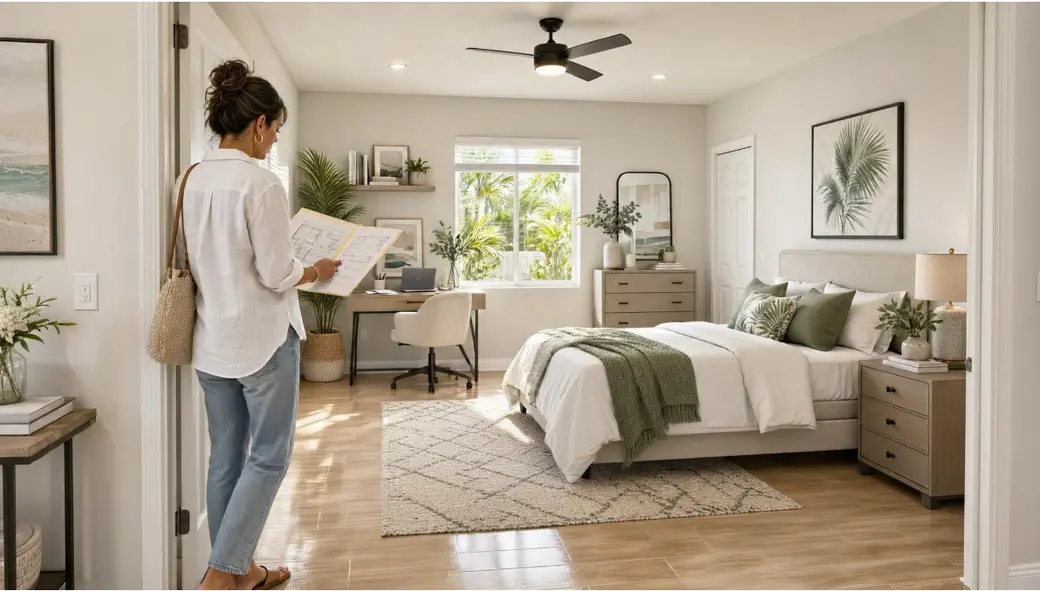
That extra bedroom may look beautiful. The enclosed patio may have been part of the house for 20 years. The remodeled bathroom may function perfectly.
But before a buyer or seller assumes everything is in order, there is another question worth asking:
Was the work permitted when a permit was required, and were the required inspections completed?
In Miami-Dade, an open permit, expired permit, unpermitted improvement, and code violation are not the same thing. Finding one also does not automatically mean a property is unsafe or that a sale cannot move forward.
The goal is to understand what the record actually shows, what work exists at the property, and what needs to be clarified before deadlines make the issue more difficult.
Key Takeaways
- An open permit generally means a permit exists in the record but has not been finalized or closed.
- An expired permit is different. Miami-Dade describes it as a permit where authorized work was not completed, inspected, and closed within the required timeframe.
- Unpermitted work means work was performed without obtaining a permit when a permit was required.
- A code violation is an enforcement matter involving noncompliance with applicable building or County code. It can involve unpermitted work, expired permits, unsafe conditions, or other issues.
- Not every home improvement requires a building permit.
- A permit exemption does not necessarily mean that no zoning or other approval is required.
- Unincorporated Miami-Dade and incorporated municipalities do not use exactly the same permitting office.
- Permit history and code-enforcement history should be checked separately.
- A finished improvement can exist for years without having generated a recorded code violation.
- Buyers and sellers should verify the facts before assuming an unusual room or improvement is either legal or illegal.
First, Understand the Four Terms People Often Mix Up
These terms sound similar but describe different situations.
|
Term |
What It Generally Means |
First Question to Ask |
|
Open permit |
A permit exists but has not yet been finalized or closed in the permit record |
Is the permit still active, and what inspections or steps remain? |
|
Expired permit |
A permit was issued but the work was not completed, inspected, and closed within the applicable timeframe |
What does the building department require to resolve or reactivate it? |
|
Unpermitted work |
Work was performed without a required permit |
Did this specific work actually require a permit when it was performed? |
|
Code violation |
An enforcement case has been created for noncompliance |
What is the violation, what is its current status, and what is required for compliance? |
Miami-Dade's Building Code Enforcement division specifically identifies expired permits and work without permits as common reasons a Notice of Violation may be issued.
An Open Permit Is Not Automatically an Expired Permit
Suppose a homeowner is replacing a roof and the permit remains open because the project is still underway.
That is very different from discovering an old permit where required inspections were never completed.
The word “open” by itself does not tell you the full story.
You need to review the permit status and inspection history.
Miami-Dade's online Building Permit Selection Menu allows searches for open master permits by address, open permits by folio, inspection history, outstanding requirements, and other permit information for County-handled records.
Unpermitted Work Is Not Automatically a Recorded Code Violation
This distinction is particularly important for buyers.
Miami-Dade warns that a property may have been modified or added to without permits without a violation yet appearing in the enforcement record, because the work may never have been reported or inspected.
In other words:
No recorded violation does not necessarily prove that every improvement was properly permitted.
The reverse matters too.
If you cannot immediately locate a permit, do not automatically declare the work illegal.
First determine whether the work required a permit, which agency had jurisdiction, and whether older records exist elsewhere.
Does Every Home Improvement in Miami Require a Permit?
No.
Many construction, alteration, repair, electrical, plumbing, mechanical, roofing, window, door, pool, fence, addition, and similar projects require permits.
But there are also permit exemptions.
For properties in unincorporated Miami-Dade, the County maintains a current Permit Exemptions guide and specifically advises residents to check it because exemption rules can change.
A Major 2026 Permit-Exemption Change
Beginning July 1, 2026, Florida law created a new exemption for certain smaller residential projects.
Miami-Dade's current guidance states that qualifying work valued under $7,500 may be exempt from a building permit in certain eligible residential situations.
But this is not a blanket rule that everything under $7,500 can be completed without a permit.
The exemption does not apply to electrical, plumbing, structural, mechanical, or gas work. Properties partially or entirely within a flood hazard area are also excluded from this particular exemption, and documentation must be submitted to request the exemption.
“Permit Exempt” Does Not Always Mean “No Approval Needed”
This is another easy misunderstanding.
Miami-Dade specifically notes that some exemptions are exemptions from Florida Building Code permitting only. Other agencies or regulations can still require approvals.
For example, certain work may not require a building permit but may require a Zoning Improvement Permit.
So the correct question is not simply:
“Do I see a building permit?”
It is:
“What approvals were required for this specific work at this specific property?”
What About Converted Garages, Enclosed Patios, and Extra Bedrooms?
These are exactly the kinds of improvements that deserve a closer look because the finished space can appear completely normal.
Converted Garage
Imagine walking into a Miami home with four bedrooms.
The fourth bedroom appears to be where the original garage once stood.
That does not automatically mean something is wrong.
But converting space from one use to another can involve:
- building alterations,
- electrical work,
- air-conditioning,
- windows or doors,
- structural changes,
- zoning requirements,
- and changes in how the space is occupied.
Miami-Dade's permitting guidance says permits are generally required to construct, enlarge, alter, repair, move, demolish, or change the occupancy of structures, subject to applicable exemptions.
The right next step is not to announce that the bedroom is “illegal.”
It is to compare what exists with the applicable records.
Enclosed Patio or Terrace
A patio enclosure may involve walls, windows, doors, electrical systems, mechanical systems, or structural work.
Again, the scope matters.
An open patio or certain exterior slabs may fall within an exemption, while converting outdoor space into enclosed living space is a very different project. Miami-Dade's exemption list makes these distinctions important.
Additional Bathroom
A bathroom addition usually deserves close permit review because plumbing and often electrical work are involved.
The 2026 small-project exemption specifically does not exempt plumbing or electrical work simply because the project value is low.
Extra Bedroom Created Inside Existing Space
Even an interior room deserves context.
Was only a nonstructural interior change made?
Were electrical circuits changed?
Were windows or doors modified?
Was the property's use or occupancy affected?
The answer depends on what was actually done.
This is why permit research works best when paired with a physical inspection and an understanding of the improvement's scope.
Step 1: Determine Which Building Department Has Jurisdiction
Before searching records, determine where the property is located administratively.
This matters enormously in Miami-Dade.
Unincorporated Miami-Dade
Miami-Dade states that properties in unincorporated areas generally have folio numbers beginning with 30.
For those properties, Miami-Dade County handles the building permits and inspections discussed in its County permitting system.
Incorporated Municipality
Miami-Dade currently has 35 municipalities, and incorporated cities generally have their own building officials.
If the property is in a municipality such as Coral Gables, Hialeah, Miami Gardens, Pinecrest, Miami Beach, or another incorporated area, start with that municipality's building department for its local permit records and procedures.
Miami-Dade specifically instructs property owners in incorporated areas to work with the municipality's building department and notes that the County may still participate when certain County-level approvals are required.
Not Sure Which Jurisdiction Applies?
The Miami-Dade Property Search can help identify the property and folio, and Miami-Dade advises owners to use the Property Appraiser or its municipal-code resources to determine the correct jurisdiction.
Practical rule: Do not assume that searching Miami-Dade County records alone gives you the complete permit history for a property inside a municipality.
Step 2: Search the Permit History
For an unincorporated Miami-Dade property, begin with the County's permit-search tools.
You can search by:
- address,
- folio number,
- permit number,
- process number,
- or other available criteria.
The County's Building Permit Selection Menu includes tools for Open Master Permits by Address and Open Permits by Folio Number.
Miami-Dade also provides access to building plans and permit records for unincorporated properties through its public-record and Microfilm/Plan Library resources.
Do Not Stop at “A Permit Exists”
Finding a permit number is useful.
It does not necessarily tell you that the project was completed and finalized.
Look for:
- permit status,
- inspection history,
- required inspections,
- final inspection,
- outstanding requirements,
- and whether related trade permits exist.
For example, a remodeling project might have a master building permit plus separate electrical, plumbing, or mechanical permits.
The record needs to make sense as a whole.
Step 3: Search Code-Enforcement Records Separately
Permit history and code-enforcement history are related, but they are not the same database.
Miami-Dade provides a Building Support Case Search for unincorporated Miami-Dade and areas under County regulatory jurisdiction. It includes cases involving:
- work without permits,
- expired permits lacking mandatory inspections,
- unsafe structures,
- and other building-code violations.
Miami-Dade also provides code-enforcement citation searches and lien-related research services.
This is why a good property review asks two separate questions:
What permits exist?
and
What enforcement cases or violations exist?
Step 4: Compare the Records With the Property You Can Actually See
This is where the extra bedroom example becomes useful.
Suppose the home's current layout shows:
- four bedrooms,
- three bathrooms,
- an enclosed terrace,
- and a remodeled garage.
But the available records show only:
- the original three-bedroom layout,
- one bathroom renovation permit,
- and a roof permit.
That mismatch does not prove every additional improvement was illegal.
It tells you there are questions worth investigating.
Ask:
What changed?
When?
Was the work exempt?
Was it performed under a permit that has not yet been located?
Was it handled by a municipality instead of the County?
Were plans archived separately?
Did the project involve work that actually required permitting?
This is much more productive than jumping directly from “I cannot find it” to “the house is illegal.”
For buyers already working through broader property-condition questions, my guide What If You Buy the Wrong Home? provides a useful companion checklist.
What Should a Buyer Do If Something Does Not Match?
Do not panic.
Do not ignore it either.
First, Identify the Exact Issue
There is a big difference between:
- a recently issued active permit awaiting final inspection,
- a decades-old expired permit,
- a room for which no permit has yet been located,
- an existing work-without-permit enforcement case,
- and a recorded lien.
Do not negotiate a solution until you understand which problem you actually have.
Second, Ask the Correct Building Department What the Record Means
Permit databases can contain old records, incomplete descriptions, multiple related permits, and terminology unfamiliar to consumers.
If something is unclear, contact the building department with the address, folio, and permit number.
For technical questions, Miami-Dade may direct an owner to permit staff or require help from a qualified contractor, architect, or engineer depending on the situation.
Third, Determine What Resolution Would Require
Miami-Dade says existing work performed without a required permit can sometimes be permitted and inspected after the fact.
That is why the cost of resolving unpermitted work cannot responsibly be estimated from the words “no permit found.”
The answer depends on what was built and what the building department requires.
Fourth, Decide How the Issue Fits Into the Transaction
Possible approaches can vary.
A seller may decide to investigate or resolve the issue.
A buyer may request additional information before proceeding.
The parties may address responsibility through their contract or negotiations when appropriate.
Professional advice may be needed for legal, technical, insurance, financing, title, or code questions.
There is no responsible universal rule that says:
“Never buy a home with an open permit.”
There is also no responsible rule that says:
“It has been there for years, so don't worry about it.”
Understand the issue first.
Can an Old Permit Be Resolved?
Often, there is a process to investigate it.
Miami-Dade advises property owners dealing with expired permits to contact the Building Department to determine the requirements for that specific permit. Depending on the circumstances, resolution can involve extending, renewing, reissuing, replacing, completing, inspecting, or otherwise addressing the permit record.
For certain older construction, Miami-Dade also has a Code Relief program for qualifying structures built without proper permits or permits lacking mandatory inspections. The County says the current property owner is ultimately responsible for bringing eligible property into compliance.
Do not assume Code Relief applies to every old improvement. Eligibility is specific.
What Sellers Should Check Before Listing
A seller does not need to conduct a forensic reconstruction of the property's entire history before putting a home on the market.
But reviewing obvious questions early can be useful.
Consider:
- Search the appropriate permit history.
- Review any permit that still appears open.
- Check available enforcement records.
- Think about major improvements made during your ownership.
- Gather permits, final inspections, plans, warranties, and contractor information you already possess.
- If something appears inconsistent, investigate it before assuming either that it is a problem or that it can be ignored.
This is especially useful when a property has:
- a garage conversion,
- room addition,
- enclosed terrace,
- added bathroom,
- pool,
- major roof work,
- substantial electrical or plumbing upgrades,
- or another visible change.
If you discover work that may need attention, deciding what to address before selling is a separate financial question. My guide to selling a Miami home as-is versus making repairs first can help frame that decision.
A Special Disclosure Rule for Unincorporated Miami-Dade
Sellers of residential property in unincorporated Miami-Dade County are required to provide purchasers with a disclosure addressing illegal construction and outstanding code violations when entering into the purchase contract.
Miami-Dade's required disclosure also warns buyers that many standard home inspections do not check specifically for illegal construction or outstanding building and zoning code violations.
This is another reason jurisdiction matters.
Do not automatically assume the same County disclosure procedure applies identically inside every municipality.
What Buyers Should Check Before Making the Issue Someone Else's Problem
Miami-Dade's buyer guidance makes a particularly important point:
A property can contain unpermitted construction even when no violation has yet been recorded.
The County also warns prospective buyers that after they take ownership, they may become responsible for correcting illegal construction and resulting fines if a violation is later identified.
That does not mean every buyer should fear older renovations.
It means permit due diligence is worth doing before ownership changes, when there is still time to ask questions and understand the facts.
If a possible permit problem is discovered during a purchase, investigate it promptly and review the applicable contract deadlines before assuming there will be additional time to obtain records, inspections, or professional opinions.
Five Things Not to Assume
1. “There is no code violation, so everything must be permitted.”
Not necessarily.
Unpermitted work may exist before enforcement ever identifies it.
2. “I cannot find a permit, so the work must be illegal.”
Not necessarily.
The work might have been exempt, recorded under another permit, located in municipal records, or require further archival research.
3. “The permit is open, so something is definitely wrong.”
Not necessarily.
Check whether it is active, what inspections remain, and whether the work is still underway.
4. “The work cost less than $7,500, so no permit was required.”
Not necessarily.
The 2026 small-project exemption contains significant exclusions, including electrical, plumbing, structural, mechanical, and gas work, as well as certain flood-hazard properties.
5. “The improvement has been there for 20 years, so it must be fine.”
Age does not establish permitting status.
Research the record.
A Simple Miami Permit Due-Diligence Checklist
For a buyer:
Identify jurisdiction → search permits → search code cases → compare records with the physical property → clarify mismatches → understand resolution before taking ownership.
For a seller:
Identify jurisdiction → review your permit history early → gather records → investigate obvious discrepancies → understand your options before the transaction is under deadline pressure.
Neither process requires assuming the worst.
It simply replaces uncertainty with information.
Bottom Line
Open permits, expired permits, unpermitted work, and code violations are related, but they are not interchangeable.
An extra bedroom, enclosed patio, converted garage, or remodeled bathroom should not automatically be labeled illegal simply because a permit is not immediately visible.
At the same time, a clean-looking renovation should not be assumed compliant merely because nobody has complained about it.
The practical approach is straightforward:
Find the correct jurisdiction.
Review the permit history.
Check enforcement records separately.
Compare those records with the property.
Then investigate anything that does not make sense.
For buyers, that means understanding what you may be taking ownership of.
For sellers, it means identifying questions early enough to consider your options calmly.
The goal is not to create fear around an older home or renovation.
It is to make sure that a room which looks like part of the house on Saturday also makes sense when someone starts reviewing the records on Monday.
This article provides general educational information and is not legal, engineering, building-code, title, insurance, or contracting advice. Permit requirements and resolution procedures depend on the property's jurisdiction, project scope, dates, and individual circumstances.
Frequently Asked Questions
What is an open permit in Miami?
An open permit generally means a permit exists in the permitting record but has not yet been finalized or closed. The permit may still be active or may have another status, so review the permit details and inspection history rather than relying on the word “open” alone.
What is an expired permit in Miami-Dade?
Miami-Dade describes an expired permit as one where authorized work was not completed, inspected, and closed within the required timeframe. The steps required to resolve it depend on the particular permit and circumstances.
Is unpermitted work the same as a code violation?
No. Unpermitted work means work was performed without a required permit. A code violation is an enforcement matter. Miami-Dade notes that unpermitted construction can exist before an enforcement violation has been identified.
Does every home improvement in Miami require a permit?
No. Some work is exempt, but exemptions depend on the type of work, property, jurisdiction, and current law. Even permit-exempt work may require zoning or another approval.
Does work under $7,500 automatically qualify for a permit exemption?
No. Florida's 2026 small-project exemption has conditions and exclusions. Electrical, plumbing, structural, mechanical, and gas work do not qualify under that exemption, and properties in flood hazard areas are excluded. Check the current local rules before beginning work.
How do I check open permits on a property in unincorporated Miami-Dade?
Use Miami-Dade's Building Permit Selection Menu and search by address or folio number. The system includes options for open master permits by address and open permits by folio.
What if the property is inside a Miami-Dade municipality?
Start with the municipality's building department. Miami-Dade states that incorporated municipalities generally have their own building officials and permitting systems, although some projects may still require separate County approvals.
Can unpermitted work be permitted after it has already been completed?
Sometimes. Miami-Dade says permits and inspections can be performed for existing work that was completed without a required permit. Inspectors may require portions of the work to be uncovered or corrected before approval.
Does a normal home inspection check for unpermitted work?
Do not assume it does. Miami-Dade's required disclosure for residential sales in unincorporated areas specifically warns that many home inspections do not check for illegal construction or outstanding building or zoning code violations.
Should a seller fix every open permit before listing?
Not automatically. First determine what the permit represents, its status, and what the building department requires. Reviewing the issue early gives the seller more information and more time to decide how to address it.
Recent Posts







GET MORE INFORMATION